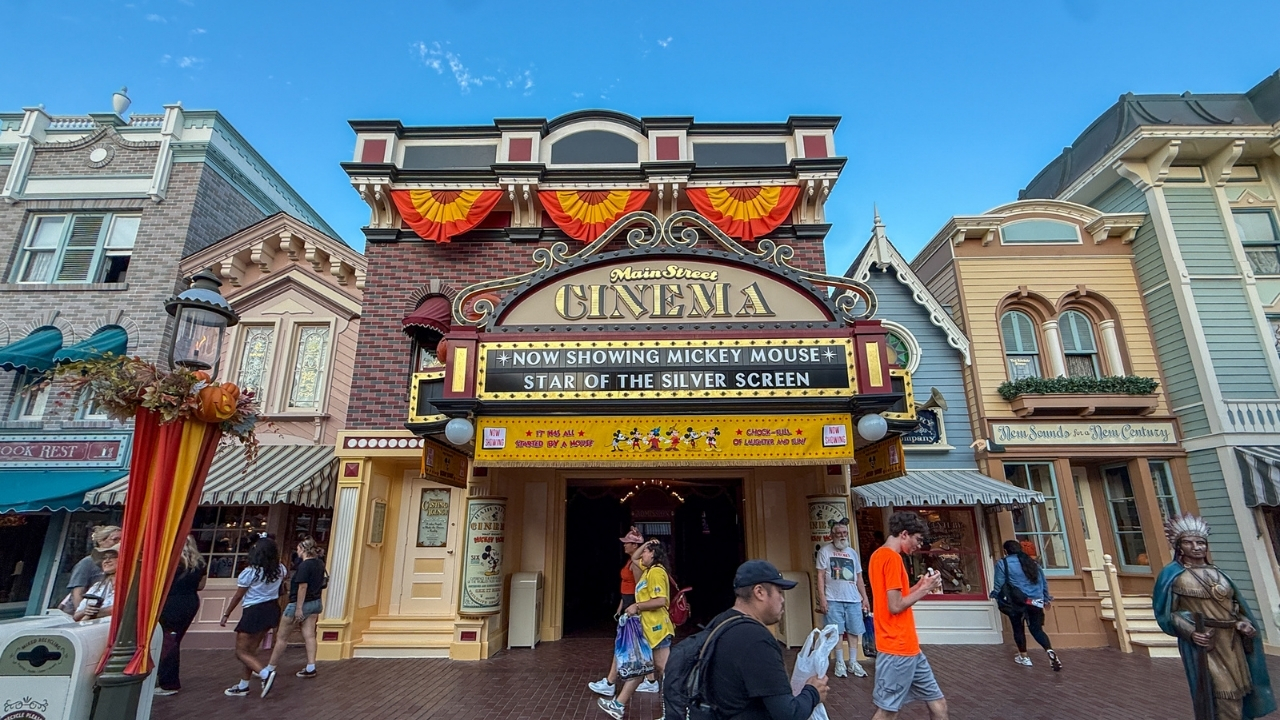
The dust has settled on initial reactions to the new program at Disneyland’s Main Street Cinema. Today, I am offering up my opinion, along with a look at what has come before. Aside from historical observations, the views expressed in this article are entirely my own.
It should be noted, with an immense amount of gratitude, that Disneyland still has an operating cinema on Main Street. As others may be aware, this Main Street Cinema is the lone survivor of what was once a little family of storefront theaters.

Walt Disney World operated its cinema from the 1971 opening until 1998. At that time, it was converted to a retail shop, with a single screen showing promotional videos. From 2005 to 2007, it was VMK Central, to promote Disney’s online Virtual Magic Kingdom. In recent years, it has been known as the Art of Disney.
Tokyo Disneyland also had a cinema on its “Main Street,” which is the glass-enclosed World Bazaar. In 2002, it was closed, and the space it had occupied became part of the expanded Emporium.
The parks in Paris and Shanghai do not have a cinema on their Main Street. When Hong Kong Disneyland opened as a clone of Disneyland in 2005, the cinema was occupied by a shop called Midtown Jewelry. Today the space, complete with facade and marquee, houses My Journeys with Duffy.
While Disneyland’s Main Street Cinema has survived, it has undergone changes. Here is what it looked like when Disneyland opened on July 17, 1955.

It was a conscious choice not to design the building to look like a purpose-built theater, but rather a storefront. This was a theater built into an existing commercial structure. The first storefront theaters appeared in 1898. The first identified as a nickelodeon opened in 1905. This fits exactly with Walt’s vision of Main Street representing America in transition at the turn of the twentieth century.
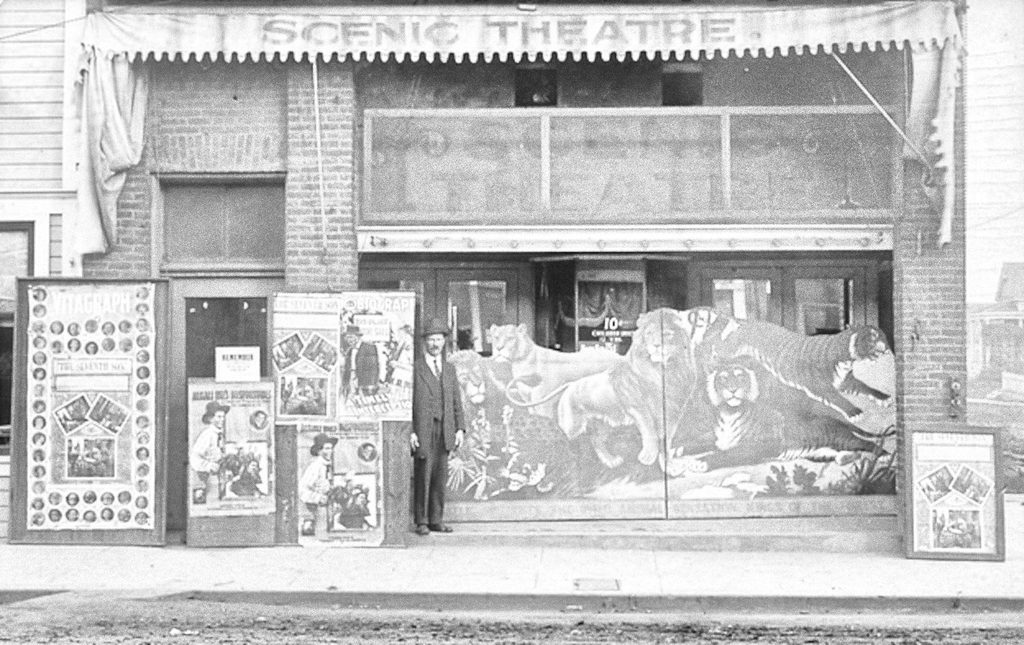
Here is an historical storefront silent movie house that was located in Portland, Oregon. The commercial building in which it is located has been outfitted with a box office and enticing publicity signs to draw customers in to see the show.


The Main Street Cinema also used alluring posters to advertise its program. These were designed for the cinema and were sometimes displayed in standing frames right out on the curb (photo detail from GoillasDontBlog).
Note that all the films advertised were true silent movies. Six were screened at the same time, changed weekly, and drawn from a library of over 100 films maintained by Disneyland. The opening day lineup at the Main Street Cinema included
“A Dash Through the Clouds,” (1912), “Dealing for Daisy,” (a William S. Hart western of 1915), “Fatima’s Dance,” (1903), ”The Noise of Bombs,” (a 1914 Keystone Kops Comedy), ”Shifting Sands,” (1918), and “Gertie the Dinosaur,” (Winsor McCay’s 1914 cartoon). There were no Mickey Mouse cartoons on the program, for the very good reason that Mickey was the first talking cartoon.
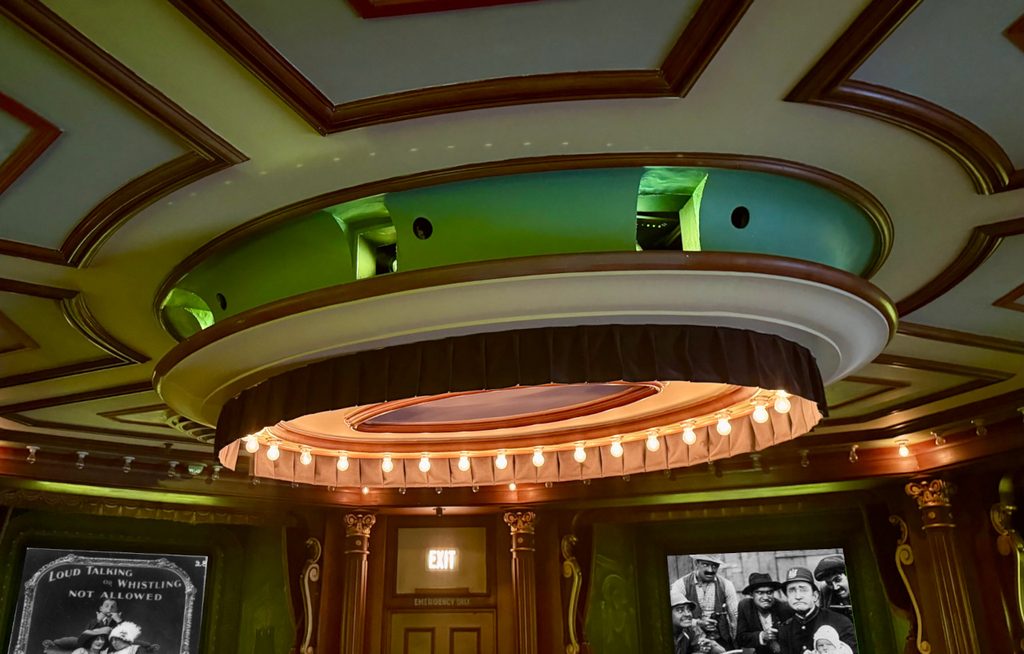
The secret of the six simultaneously running films lay in the second floor projection booth. Six projectors ran films in a continuous loop, with mirrors reflecting each down through the floor and through small windows concealed in the oval ceiling decoration located in the center of the room below.
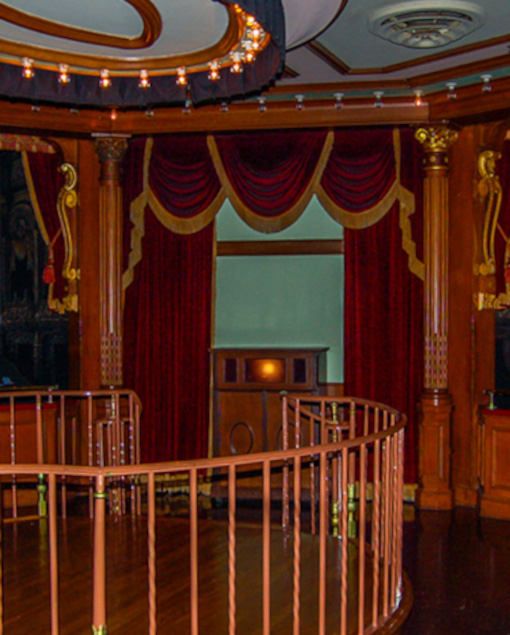
Historically, silent movies were never entirely silent. Musical accompaniment of some sort was offered, even in the humblest of the storefront cinemas. On Disneyland’s Main Street, a restored turn-of-the-century music box in the back of the venue filled the bill (photo detail from DavelandWeb).
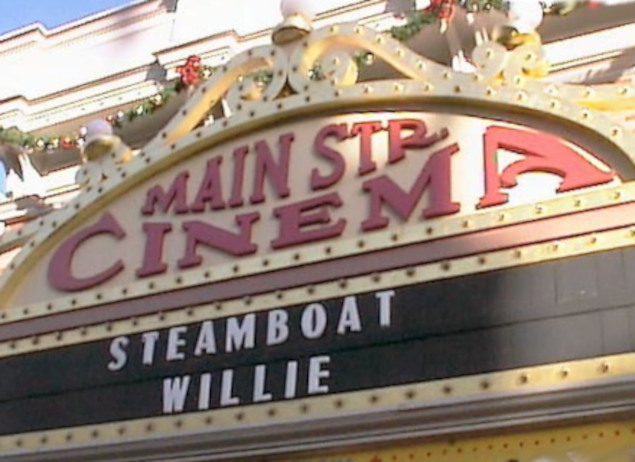
Source material is scant when it comes to identifying the exact date when the Main Street Cinema dropped silent films in favor of cartoons. Steamboat Willie was added to the marquee at Walt Disney World, in honor of Mickey’s 50th anniversary, in 1978. Likely, this was when it was added to the cinema at Disneyland. By the mid 1980s, all six screens were showing early Disney cartoons.
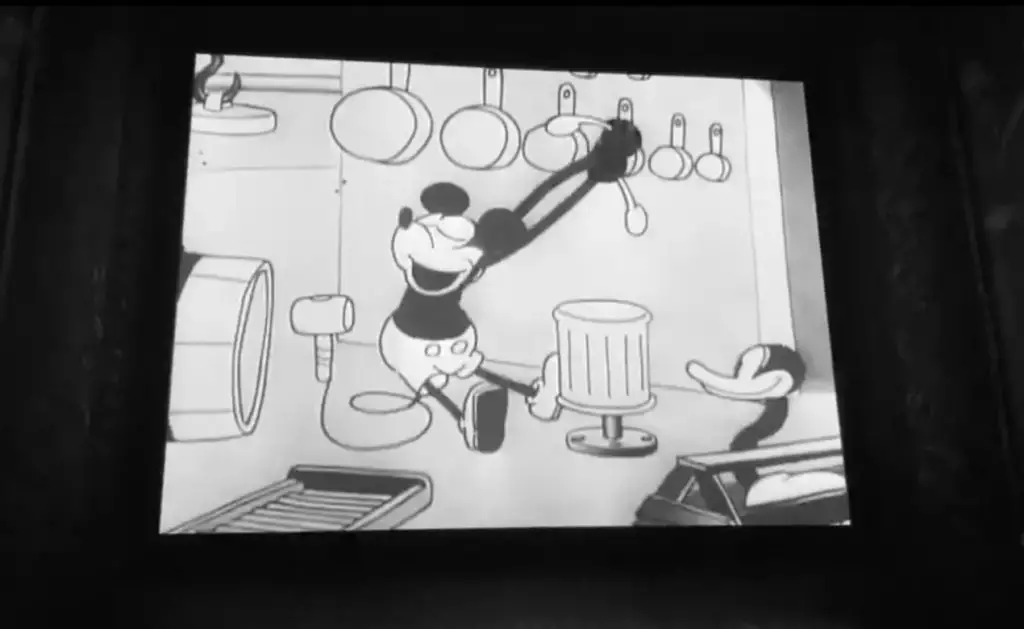
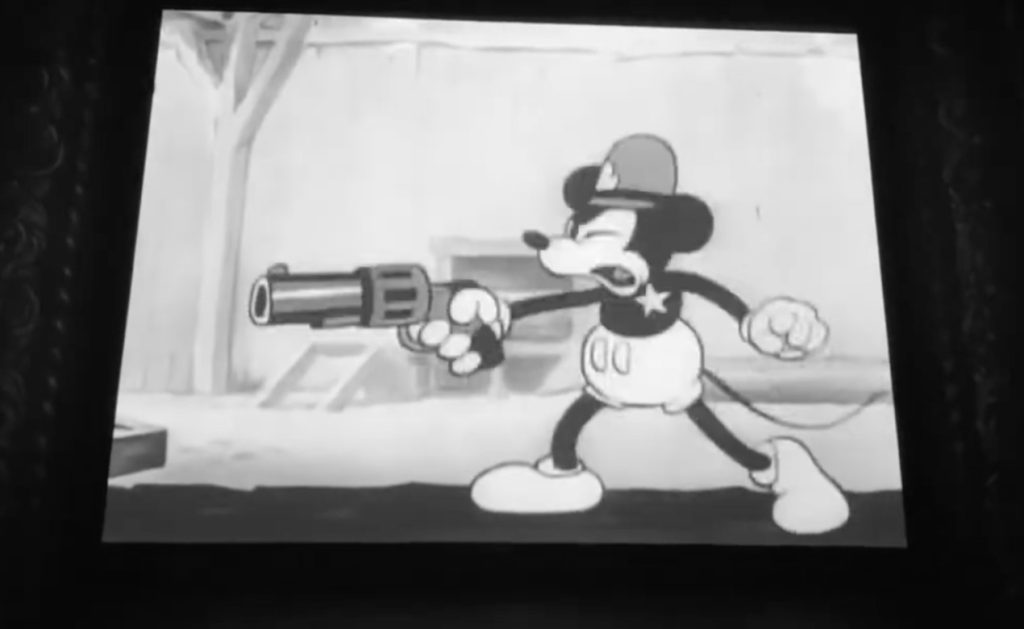
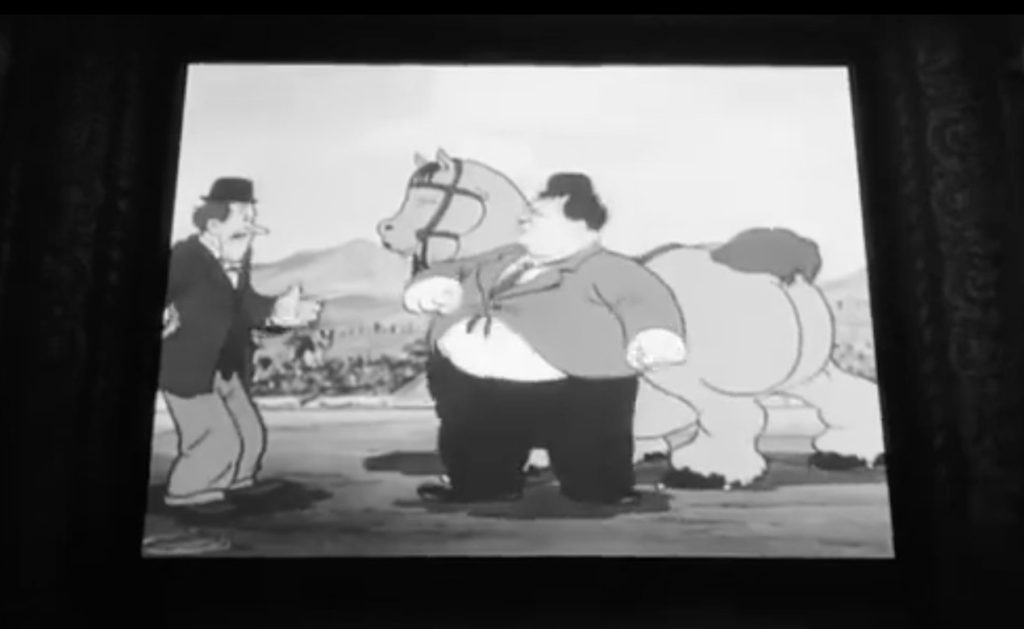
The lineup that had the longest run was “Steamboat Willie” (1928), “Plane Crazy” (1929), “Traffic Troubles” (1931), “The Moose Hunt” (1931), “The Dognapper” (1934), and “Mickey’s Polo Team” (1936). Not only was each of these cartoons originally produced with sound, but “Mickey’s Polo Team” was in color. A specially made black-and-white print was run to maintain the antique atmosphere of the Main Street Cinema.
During this same time period, the turnstiles at the entrance were removed. And at some point during these changes, a new roofline was added to the top of the building. This was the case with most buildings on Main Street, to conceal lighting fixtures that would rise into place for parades and street shows.
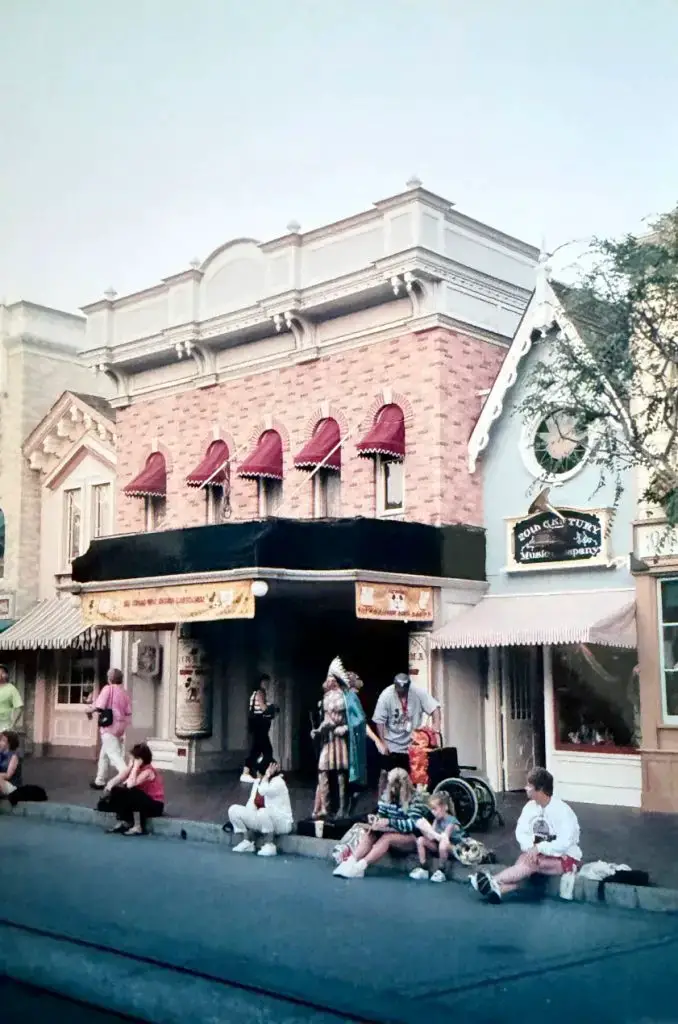
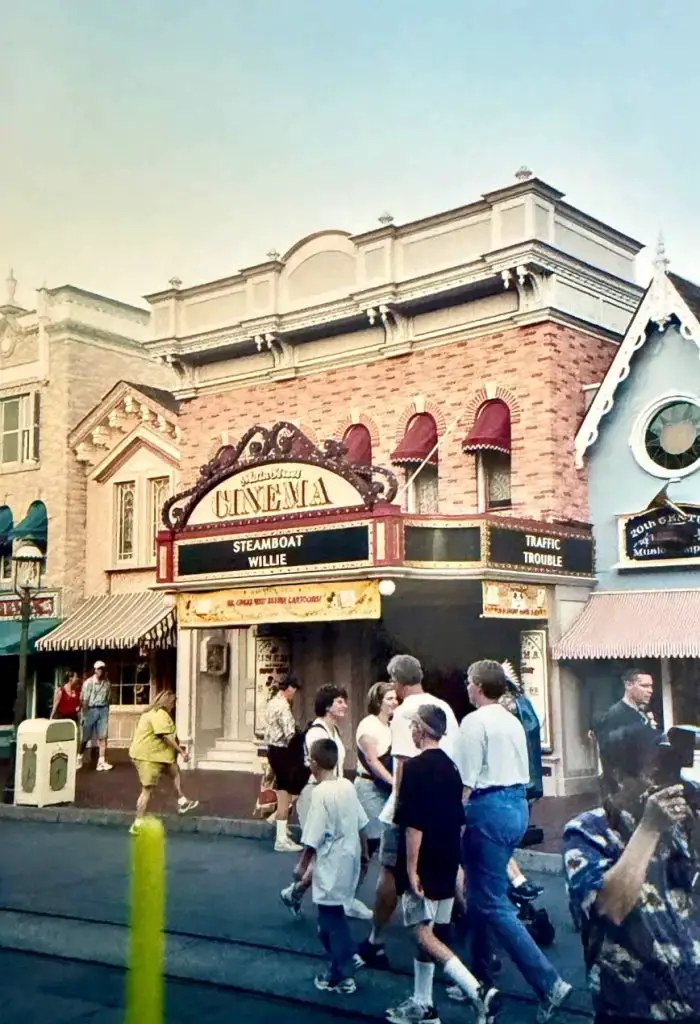
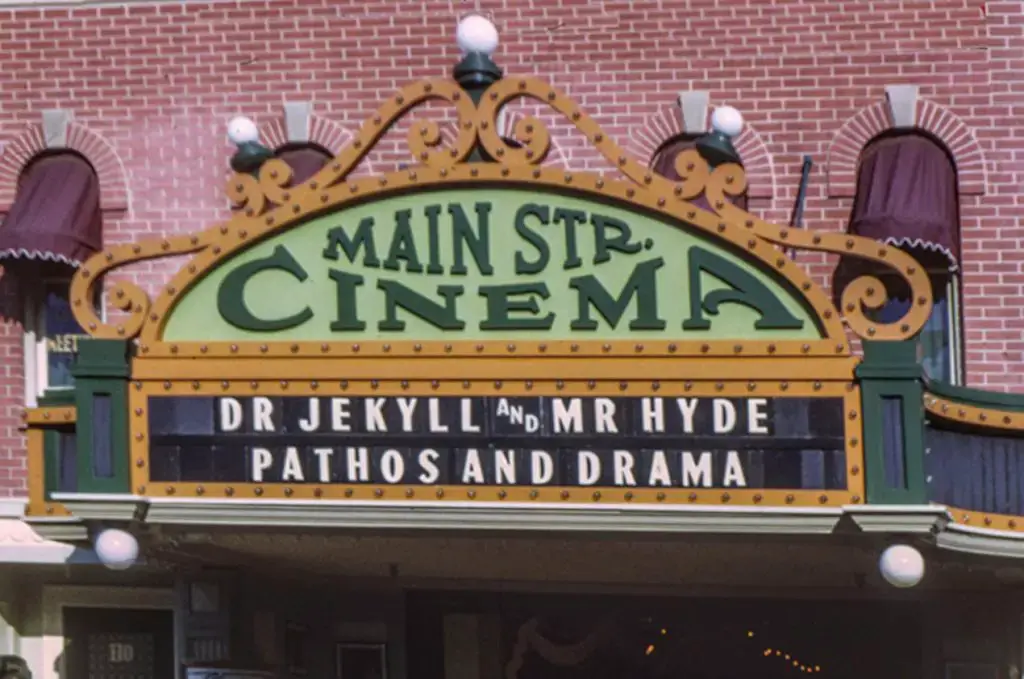
In the fall of 2003, the front of the building underwent a major change. The marquee was completely removed, and a new one appeared in its place. Gone was the quaint lettering that had graced the building since opening day, replaced by a bold new logo based on printed typography. The cresting atop the marquee was also altered, and the three white globes that accented it were removed.
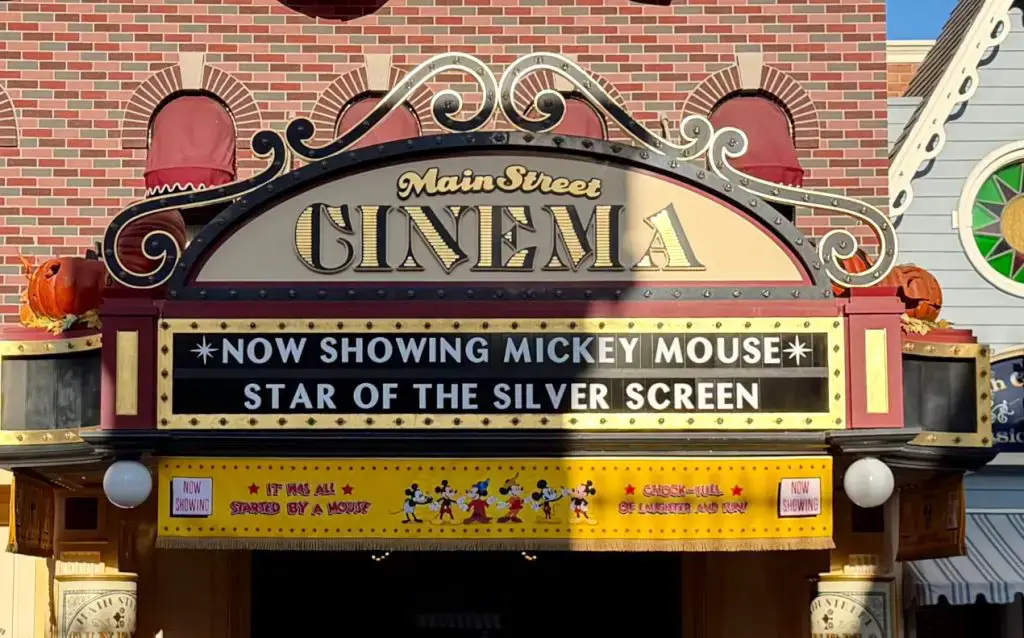
Another unheralded change had taken place inside the cinema, as well. The antique music box was removed and recorded music was put in its place. The new soundtrack was derived from a 1961 comedy album that offered zany versions of silent movie music. Recorded by Spike Jones, the album title is controversial by today’s standards. Spike used the pseudonyms “Hangnails Hennessy and Wings Brubeck” as the work’s composers, for those inclined to search out the album.
While the cinema has remained pretty much the same to this day, there were a few other changes over the years. In 2010, as part of the park’s 55th anniversary promotion, footage of Disneyland’s opening day was screened.

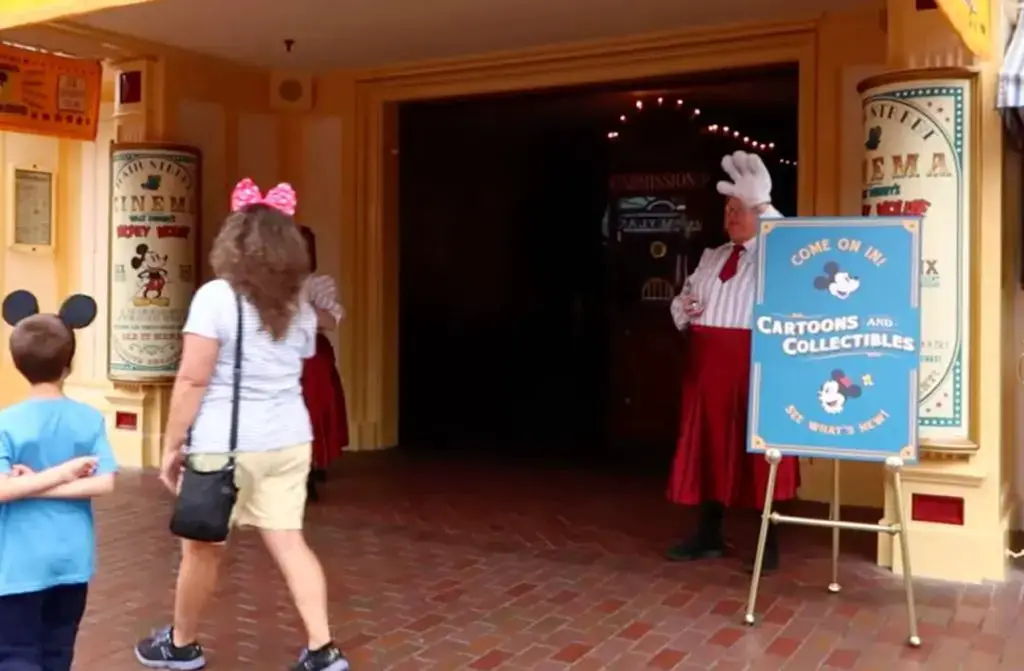
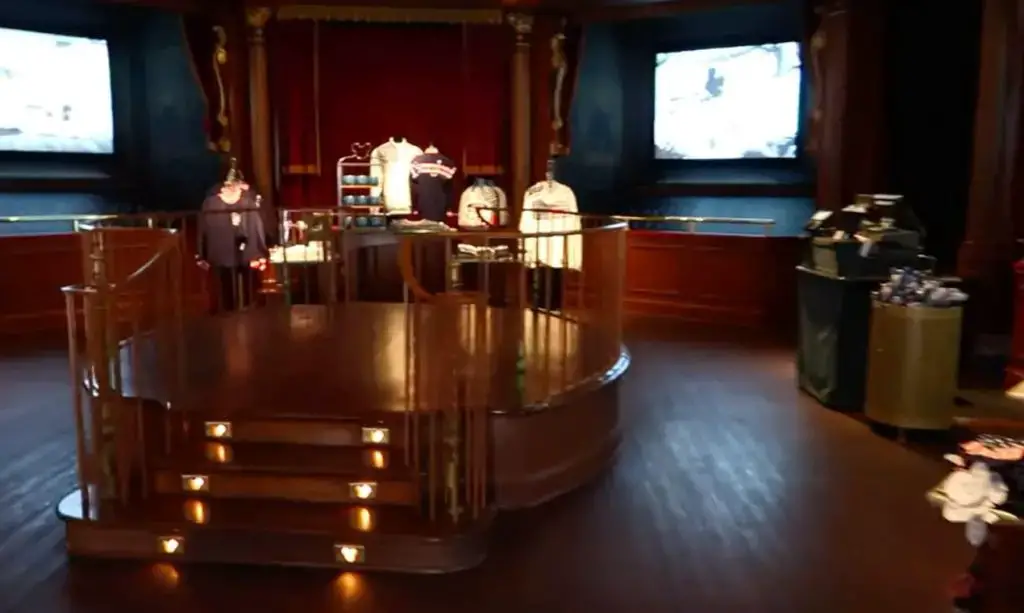
By far, the most controversial change was an experiment that lasted barely a week in 2019. That June, guests found cast members standing out in front of the cinema, beckoning them inside. For the first time since the silent film era, the cinema had sidewalk easels, advertising “Cartoons and Collectibles.” Inside, merchandise was displayed, along with a cash wrap and cash register. Negative guest reaction was swift, and the effort was removed as quietly as it had appeared.
The following year saw the closure of the Main Street Cinema, along with all Disney theme parks, as the world dealt with the COVID pandemic. It remained closed for over a year, opening its doors again on June 21, 2021, days after the rest of the park had reopened.
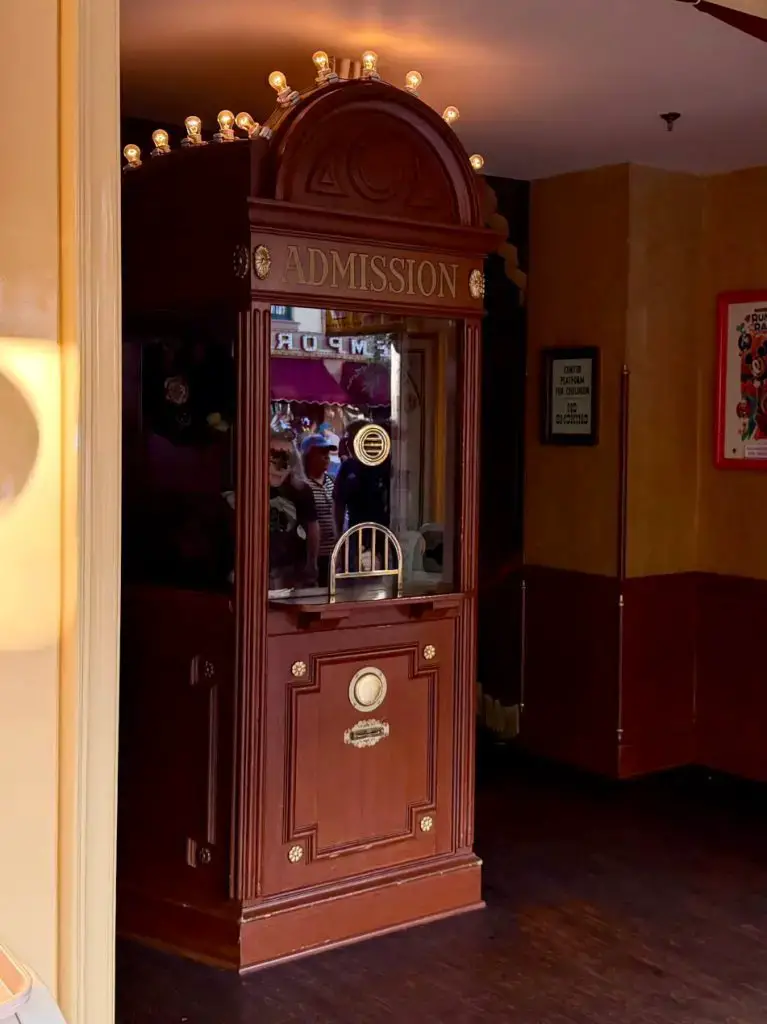
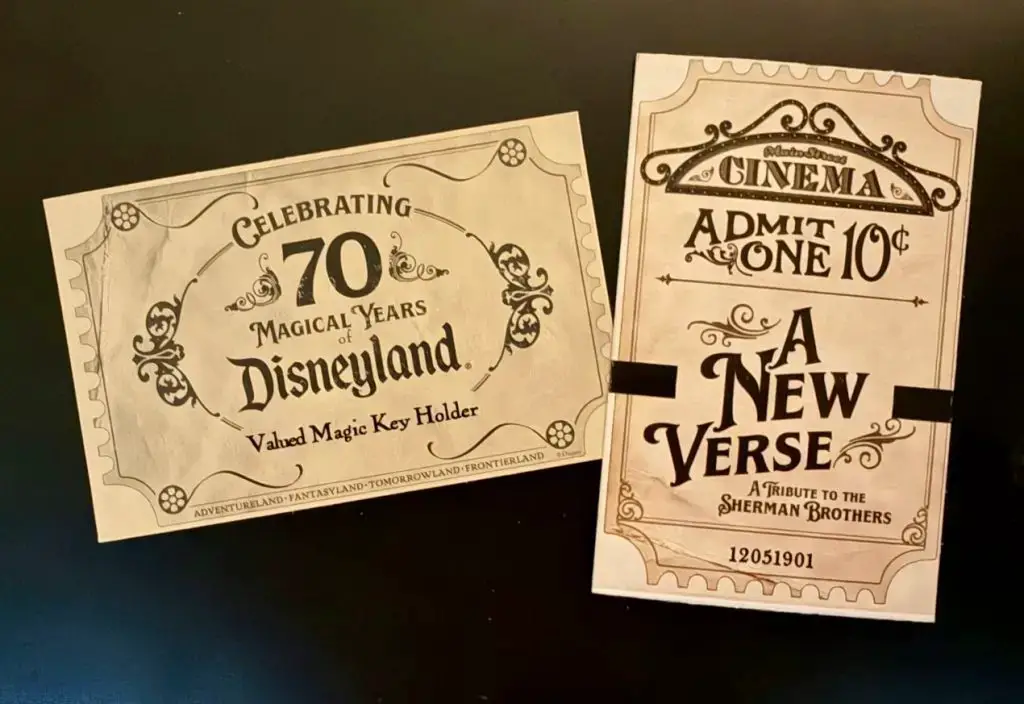
For Disneyland’s 70th anniversary in 2025, a park-wide promotion included the box office out in front of the cinema. Tilly the ticket taker, perhaps the park’s most venerable cast member, was now dispensing actual tickets! They were available for the holders of Magic Bands and were dispensed in a new slot located in the lower front of the ticket booth.

On July 17th of that year, a new show was installed in the Main Street Cinema. “So Much That We Share” was a loving tribute to the Sherman Brothers. Inside, all six screens screened a specially produced film showing children around the world singing the Sherman Brothers’ famous theme from it’s a small world.


Outside, the cinema displayed new banners and advertising for the Sherman Brothers tribute. Disney Imagineering Legend Tony Baxter was a visitor on opening day. Several years earlier, he had proposed a new show for the cinema, one which never got off the drawing board.

All of this brings us up to the present, and that new program of Mickey Mouse shorts that has been installed in the Main Street Cinema. It consists of six modern shorts, produced between 2013 and 2019 by Paul Rudish for Disney Television Animation.

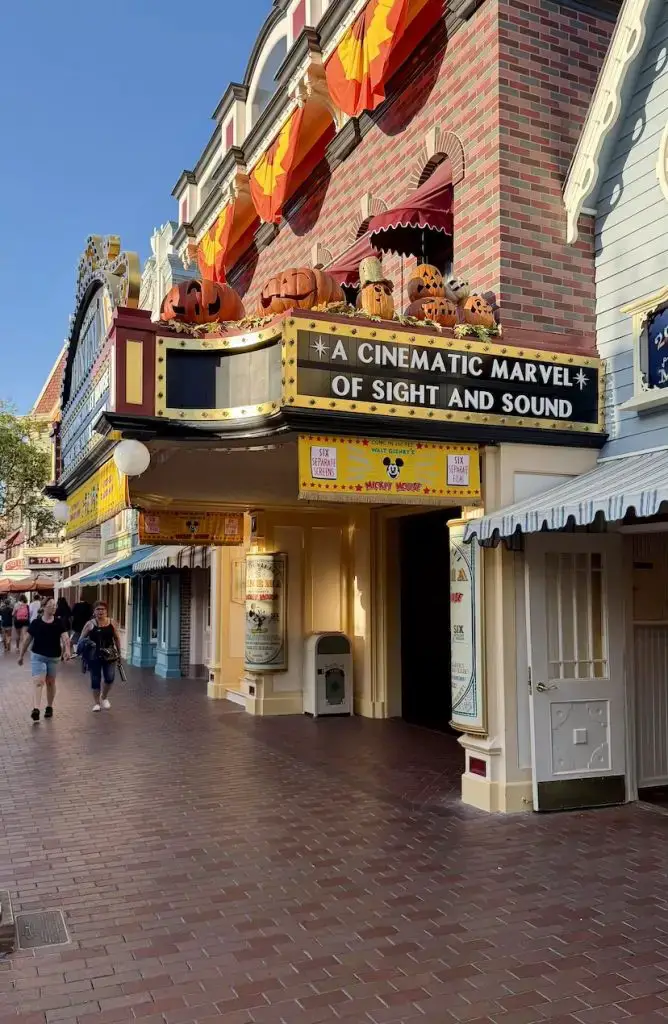


There were, of course, the usual cosmetic changes to the outside of the cinema. Fresh marquee text, banners, and posters announced the new program. Sharp-eyed guests noted the “retro” style Mickey that appeared prominently in the vertical signs.


The largest cloth banner also featured an image that was rather familiar. “Mickey Through the Years” has been used by Walt Disney Productions in slightly different forms for several decades.
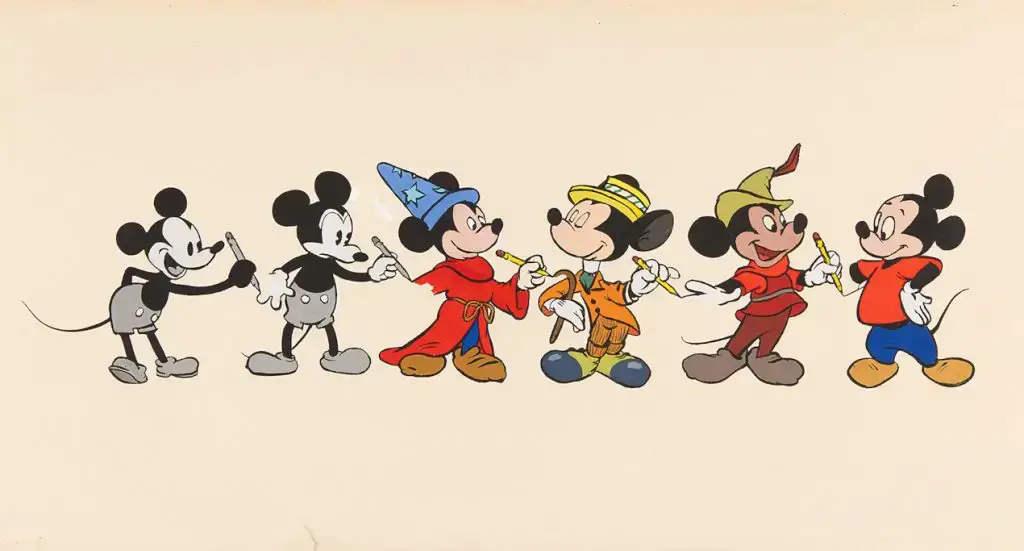
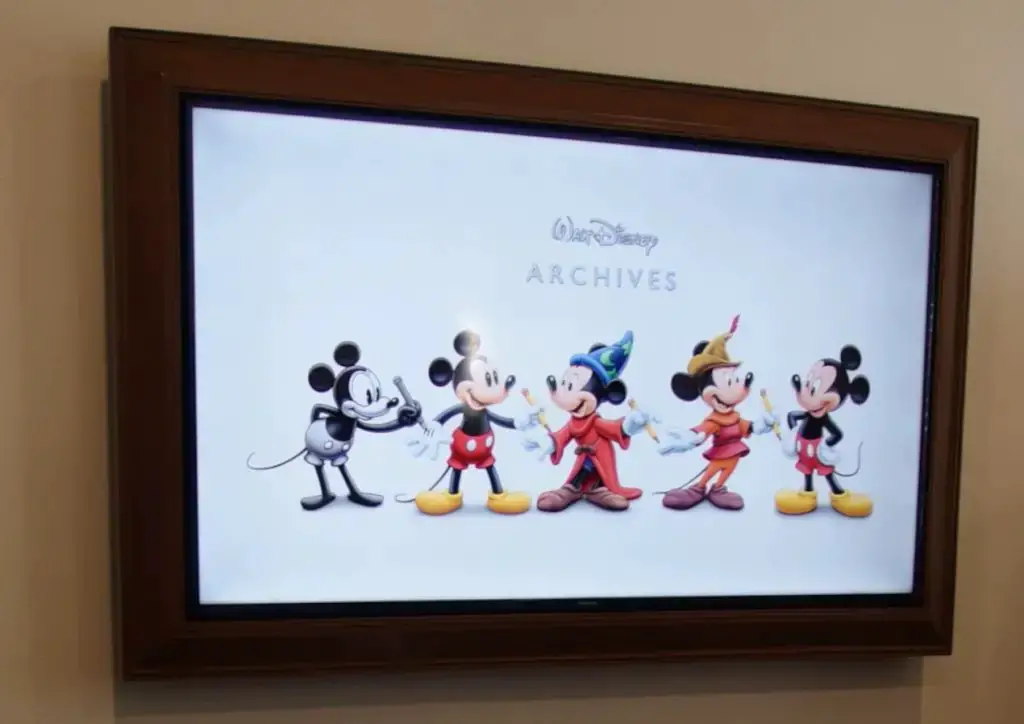
Here are two versions. The first was used in the 1950s and includes six progressive images of Mickey. The second is a standard version that is used extensively by the Walt Disney Archives. Note that the image used in the new cinema banner is this, with the newest version of Mickey oddly added in the fifth of six positions.
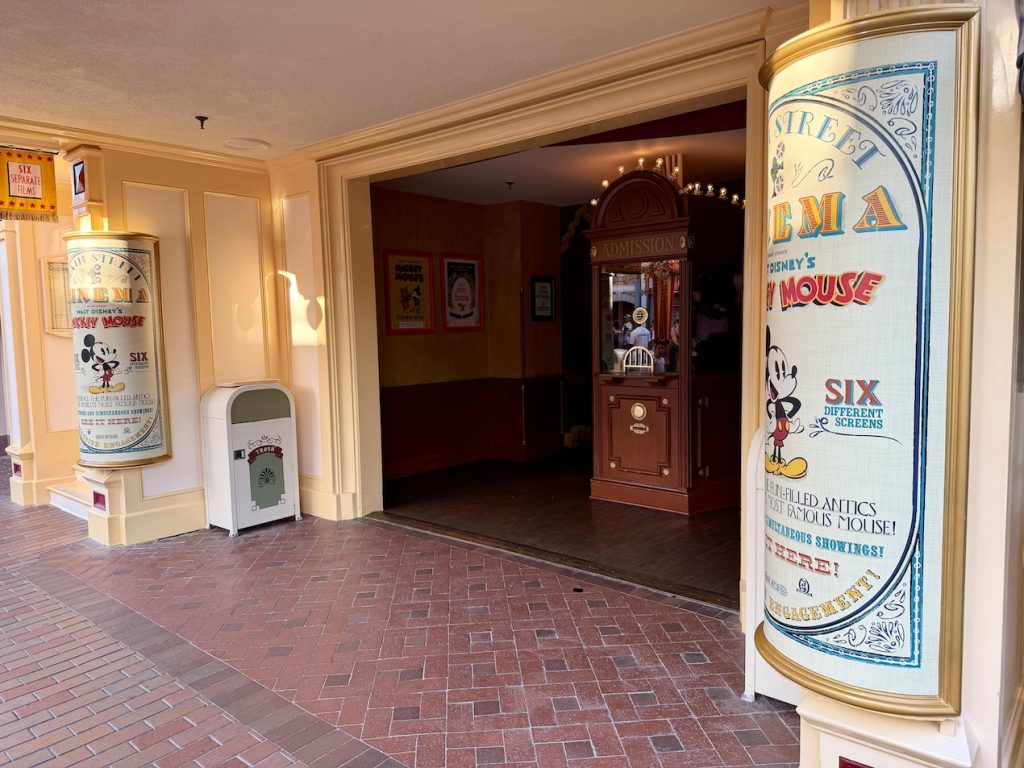
Cosmetic changes aside, the entrance to the cinema is comfortably familiar. Tilly still reigns over the box office, as guests make their way past running lights, plush velvet, and gold-fringed drapery.
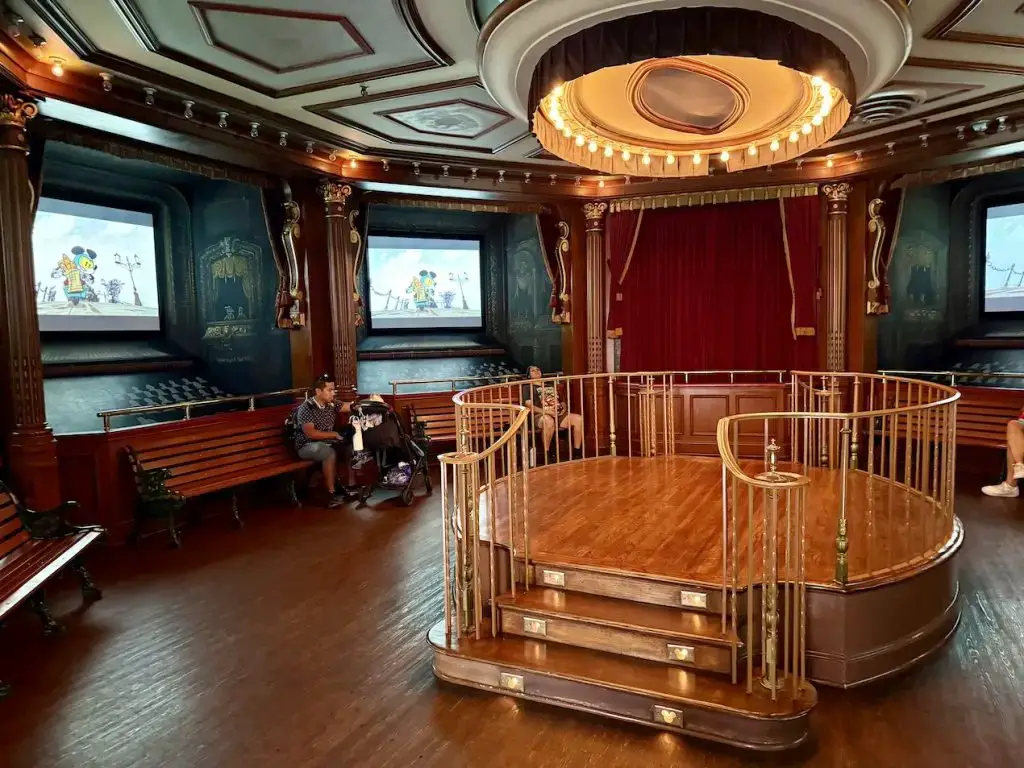
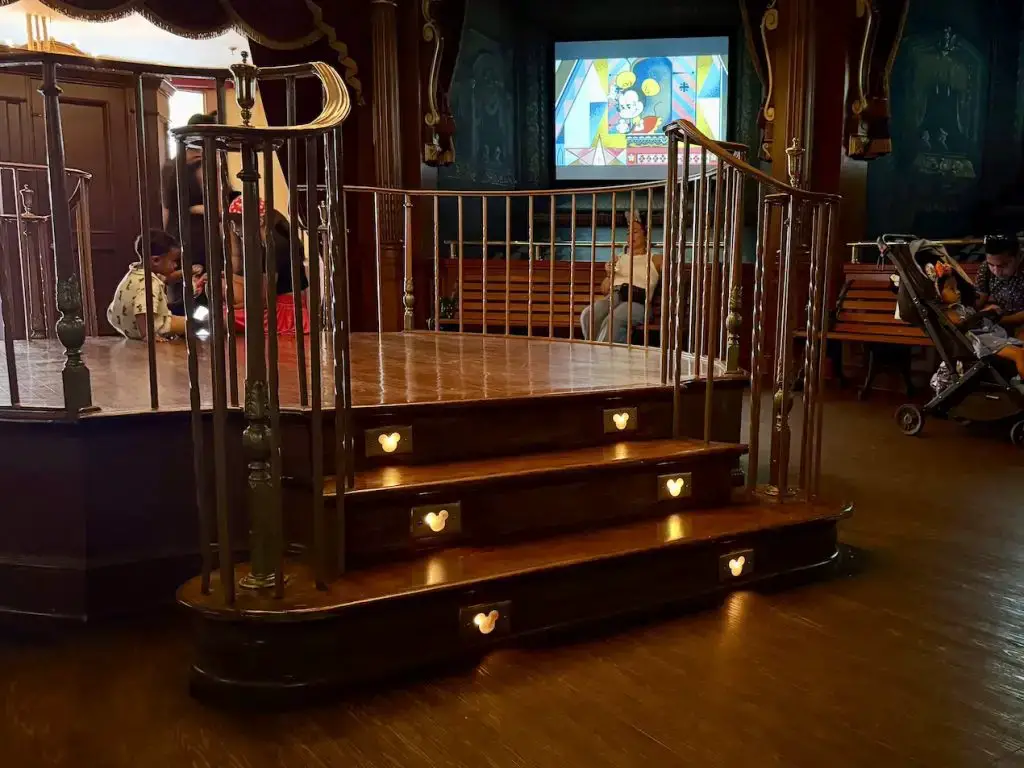
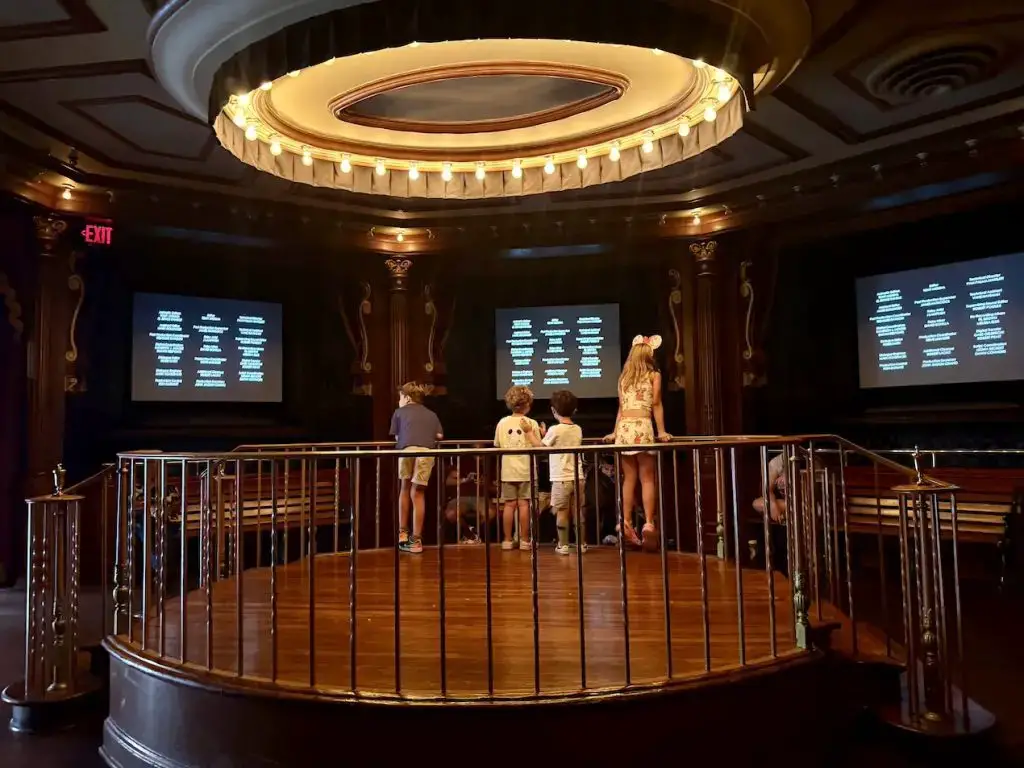
Inside are all six screens and the same center platform that has been in place since 1955. The hidden Mickeys in the stair light for the three steps are among Disneyland’s more notable Easter Eggs. The platform remains a favored viewing spot of younger, shorter guests.
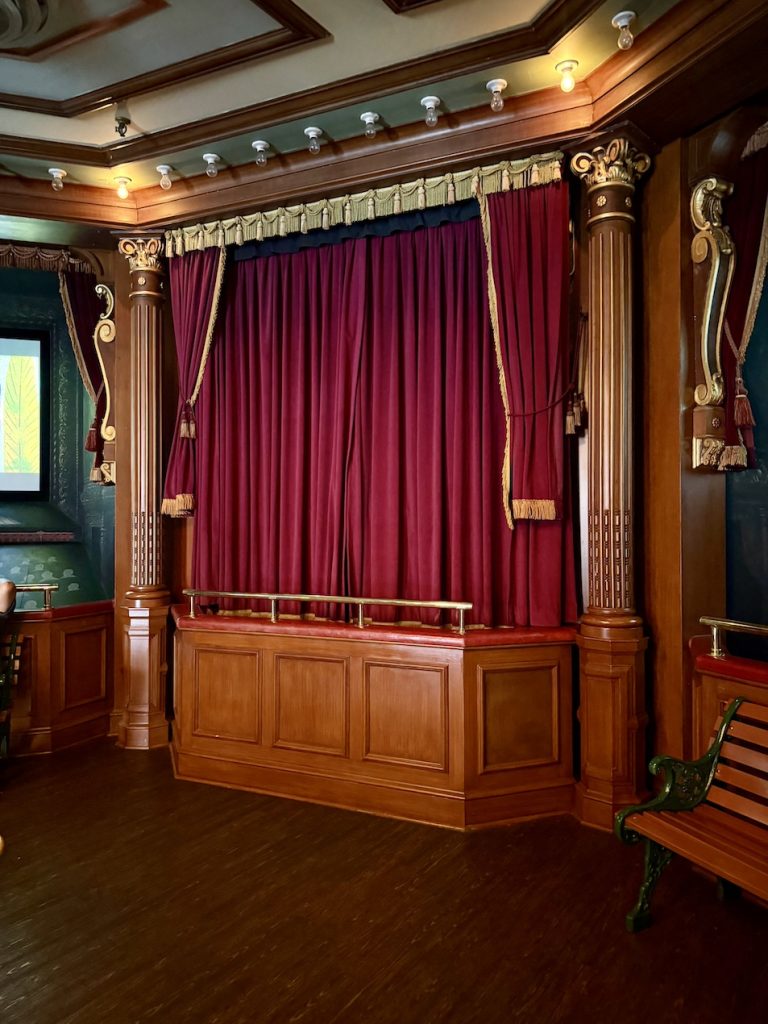
Long gone is the vintage music box that originally provided the background music for the silent films that played long ago. The space today appears as a small draped stage, with an added wainscot topped with a brass rail.
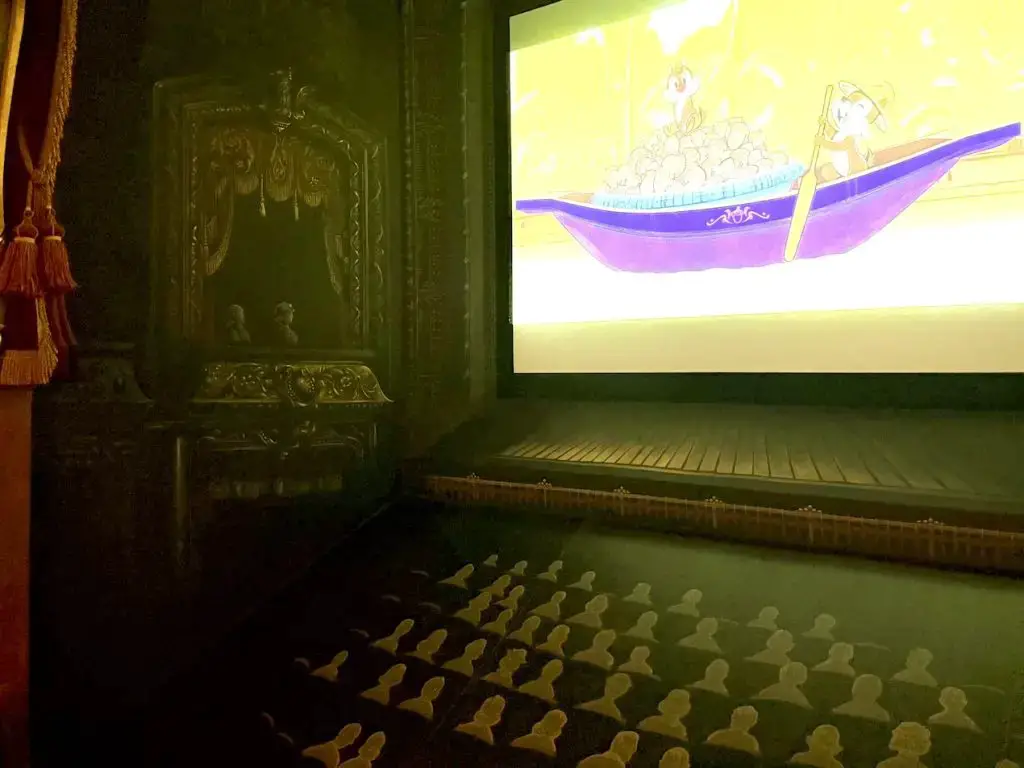
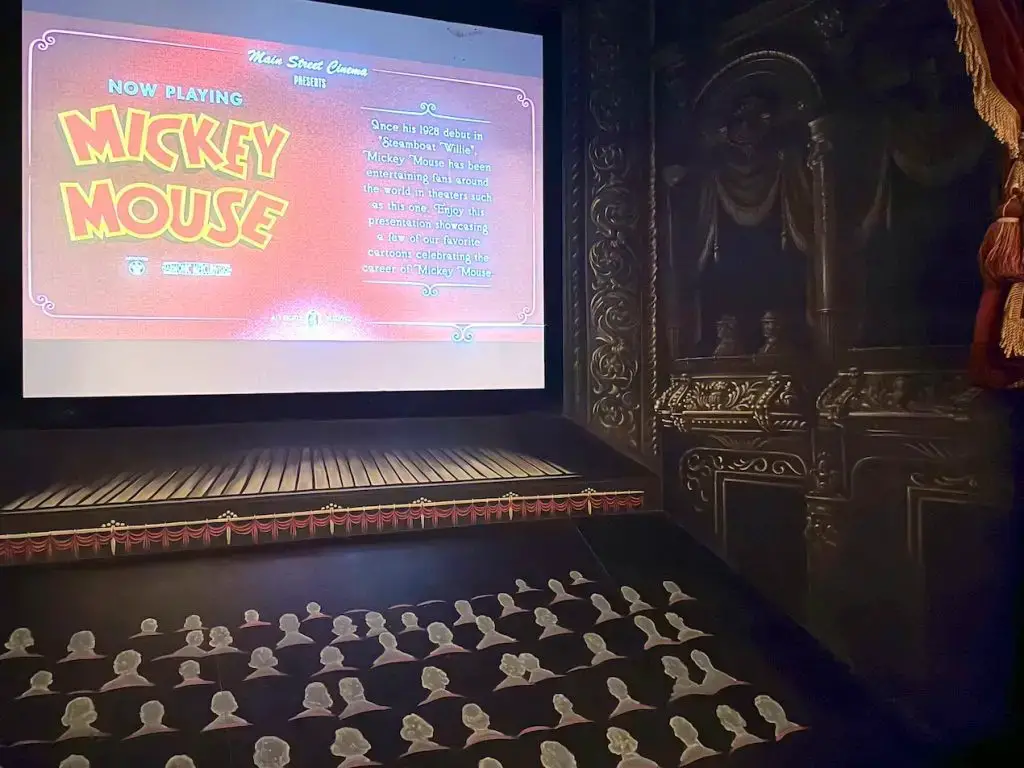
Unnoticed by many guests is a charming detail that has survived to the present. Each of the screens has its own painted proscenium, footlights, audience, and box seats. These are very subtle, and only noticeable when the screen features a brightly lit scene.
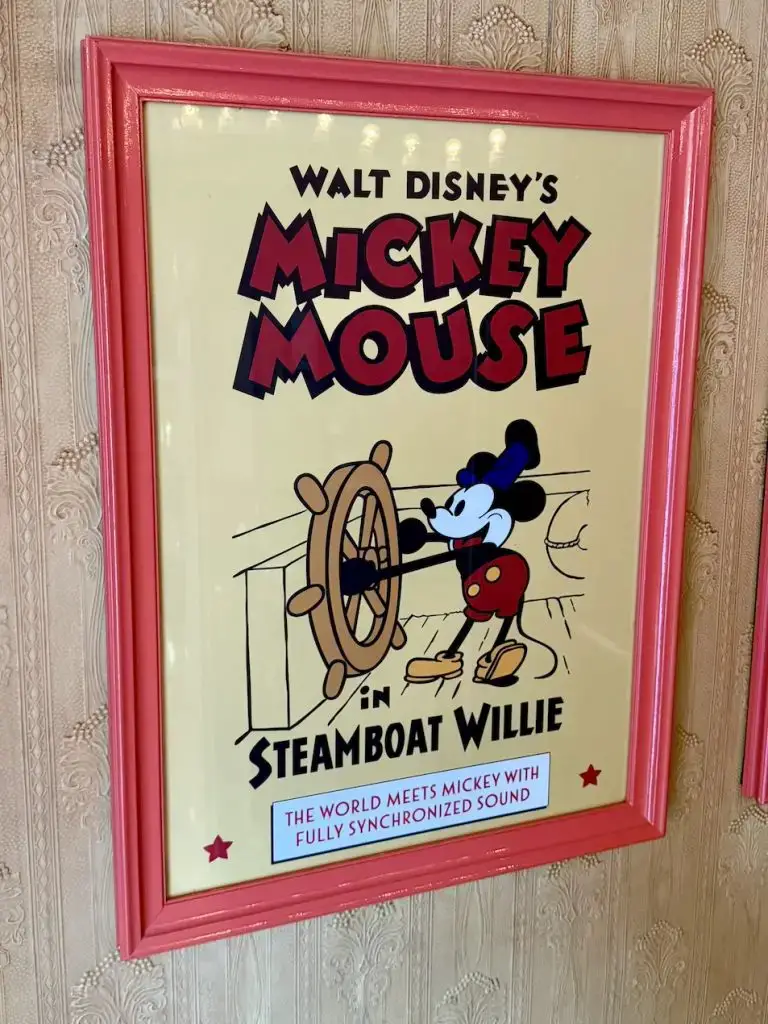
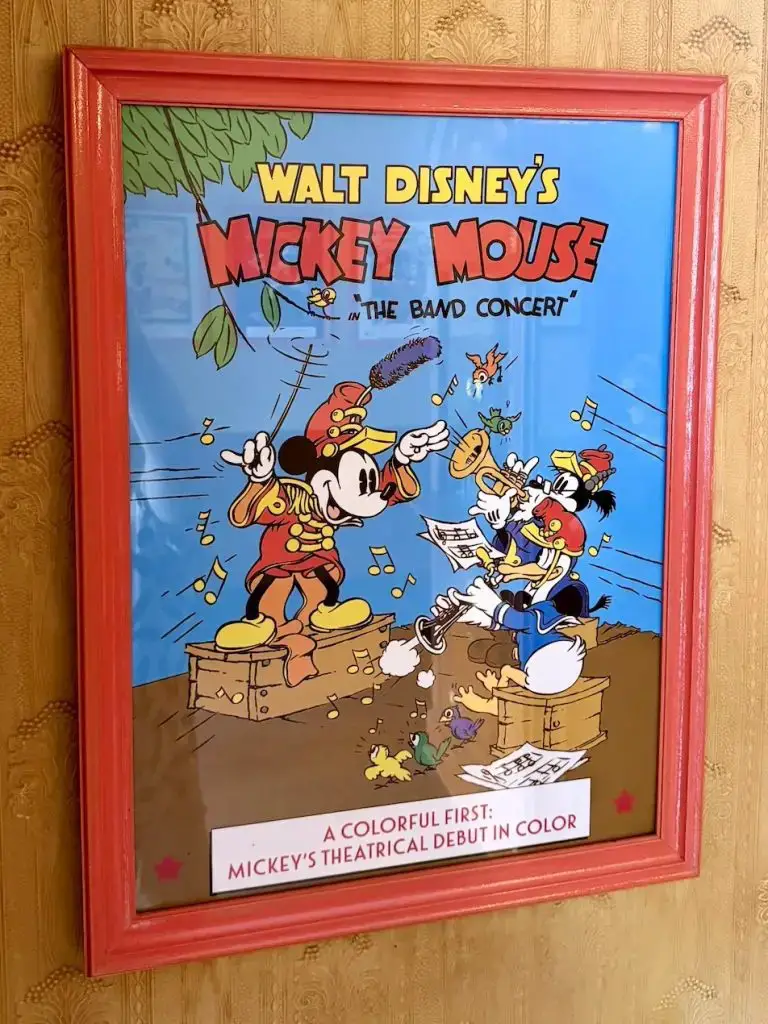
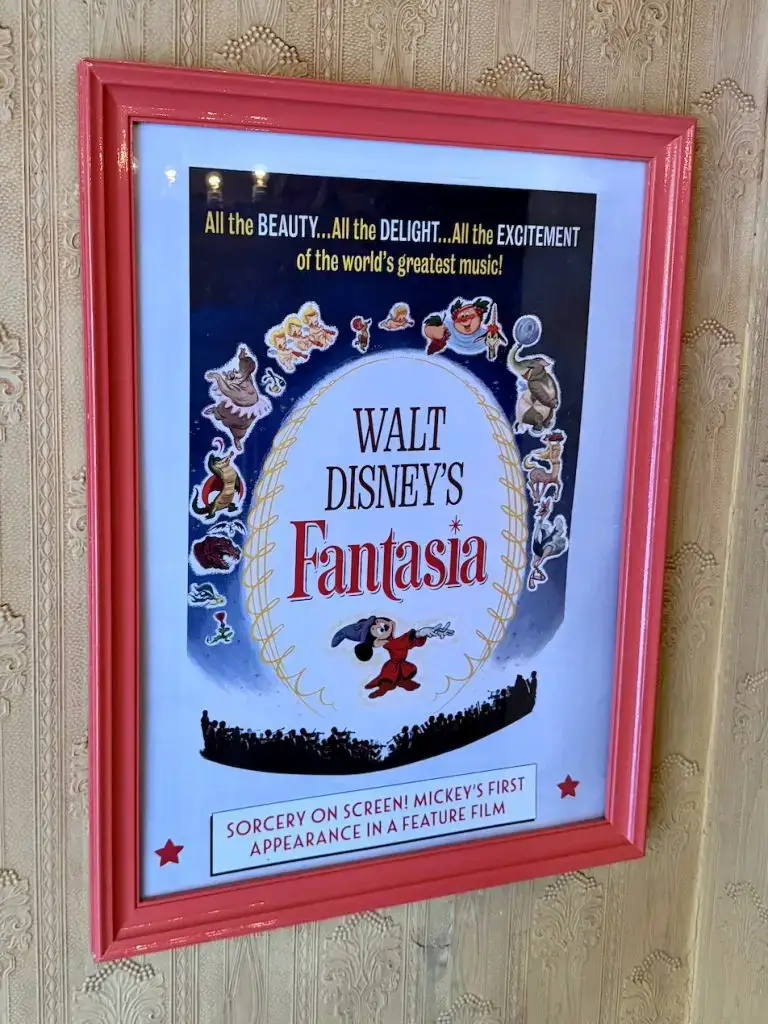

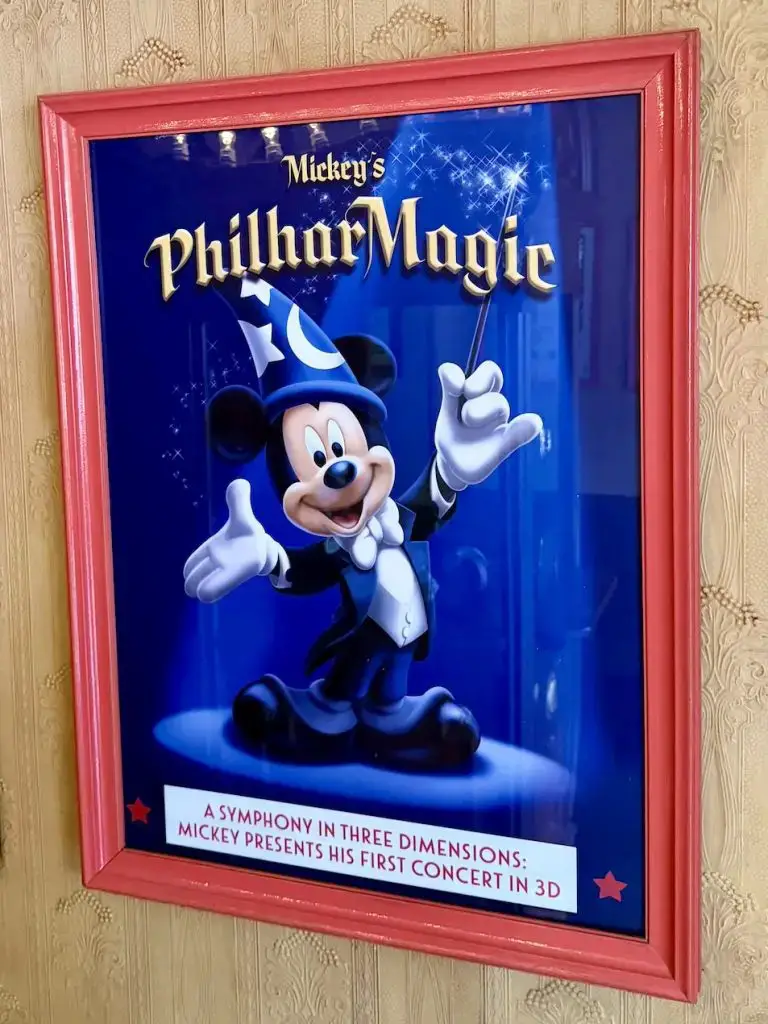
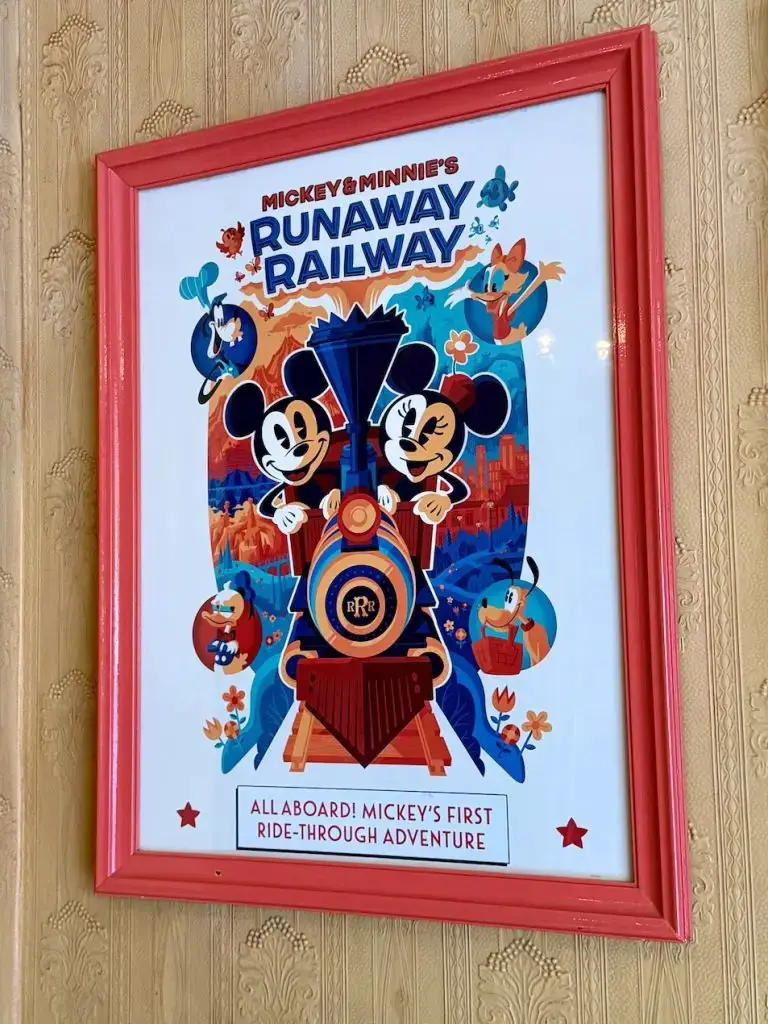
Another detail that remains from the early days is six framed posters, prominently displayed in the theater’s tiny foyer. In the past, these advertised the six films playing on the screens inside. For special promotions, they were used to offer historical context for the program. The current set appears to be an historical overview of Mickey’s film and theme park career.
Inside, between each of the six featured cartoons, a title card is displayed. It reads:
Since his 1928 debut in “Steamboat Willie,” Mickey Mouse has been entertaining fans around the world in theaters such as this one. Enjoy this presentation showcasing a few of our favorite cartoons celebrating the career of Mickey Mouse.
And herein lies my problem.
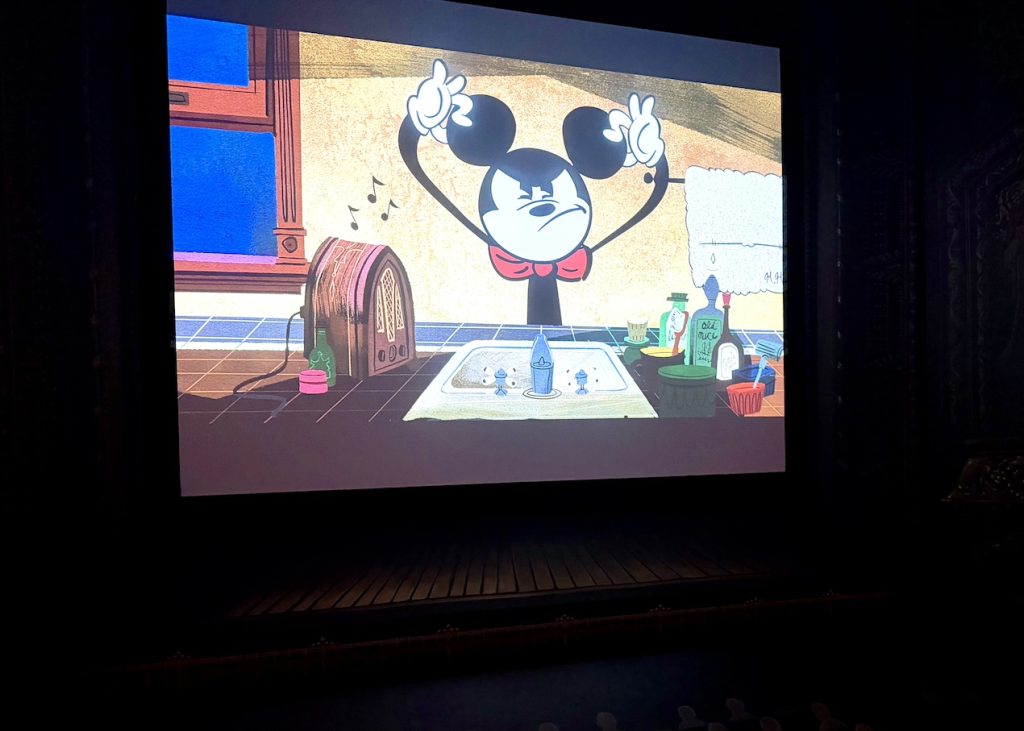
The new program does not in any sense celebrate the career of Mickey Mouse. Rather, it presents a series of six entertaining cartoons that were produced for the 2013-2019 series “Mickey Mouse.” The program now playing in the Main Street Cinema consists of the following:
- “Bad Ear Day” (2013)
- “Tokyo Go” (2013)
- “Croissant de Triomphe” (2013)
- “Yodelberg” (2013)
- “No Service” (2013)
- “Our Floating Dreams” (2019)
What this means is that the cinema is showing cartoon shorts that were designed and produced to air on broadcast and streaming services. Although there are oblique references to Disney history and Mickey’s long career in the cinema itself, none of these shorts depict that, or, indeed, were ever shown “around the world in theaters.”

Interestingly, there is one short in this series (or rather, a second series by the same producer) that would offer at least a glimpse at some of this. “Steamboat Silly” (2022) is a zany tribute to Mickey’s long career. It was the final episode and something of a coda for a series entitled “The Wonderful World of Mickey Mouse.” In “Steamboat Silly,” Mickey entertains his friends with a look at his past career, and unwittingly unleashes an army of his former personas, who proceed to wreak comic havoc across Disney’s historic legacy. The sheer volume of Easter Eggs alone would bring out many of Mickey’s most ardent fans.

But… this is not the case. As Minnie and I would observe, “Oh dear.”