The Lucas Museum of Narrative Art has an opening date. It will be open to the public starting September 22, 2026. This a museum, the first of its kind, that is dedicated to showcasing the universal tradition of storytelling through images.
The museum is founded by George Lucas and Mellody Hobson. It traces visual storytelling throughout centuries and cultures. This ranges from prehistoric cave paintings to illustration, comics, cinema, and murals. Along the way, it celebrates how stories connect, shape belief, and help people see themselves in each other.
George Lucas said, “The Lucas Museum of Narrative Art was created to honor humanity’s stories and the artists who illustrate them. The artists in this collection didn’t just create images, they connected our modern imaginations with our ancient emotions—with common beliefs creating community. Their work spans genres, media, and time. They deserve to be in a museum.”
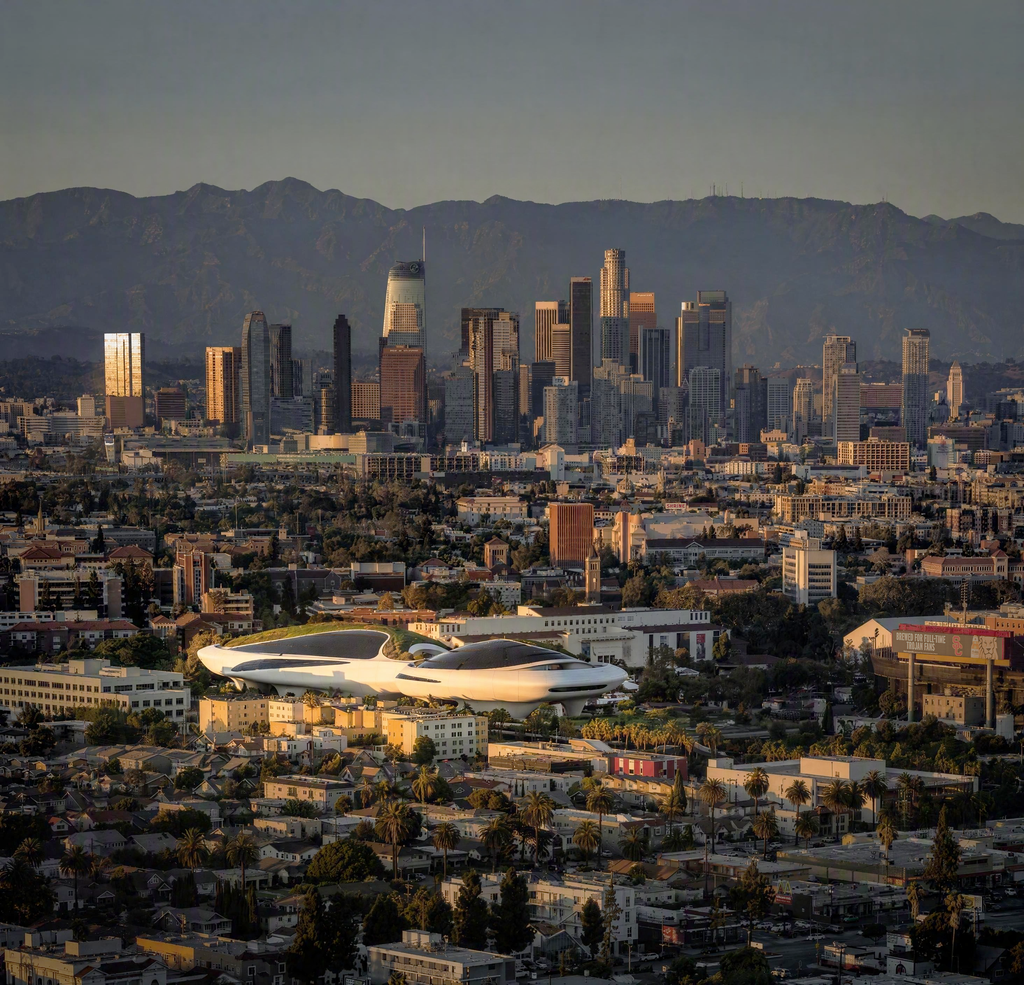
It is located in Exposition Park and has a collection that spans a wide range of eras and mediums of visual storytelling. This ranges from Artemisia Gentileschi and Norman Rockwell to Frida Kahlo, Robert Colescott, Frank Frazetta, and Robert Crumb, along with film materials that include the complete Lucas Archives (1971–2012). There are also contemporary vehicles of storytelling found in this museum. People will find that mediums like illustration, comics, and cinema, which haven’t always received the same recognition as painting, sculpture, and photography, will be found in places of honor with equal standing. This museum presents art and popular culture side by side as a part of one continuous visual tradition. The Lucas Museum also houses a free Research Library and has the destination restaurant, Skywalker Grill.
Mellody Hobson added, “We wanted a museum unlike any other — one that brings people from every walk of life through the same doors. That’s why this collection holds so many different kinds of stories: so that more people can walk in and, somewhere in these galleries, see themselves — and the world they know—reflected back. That kind of recognition is what we built this place to offer.”
Lucas Museum of Narrative Art CEO Tracey Bates said, “George Lucas and Mellody Hobson have an unshakeable faith in the power of visual storytelling to inspire not just individuals but entire societies, bringing people together around goals, beliefs, and values worth sharing. It’s incredibly rewarding to finally welcome the public through our doors. Every gallery, every program, every corner of this museum was built with our visitors in mind, and we can’t wait for people to experience it.”
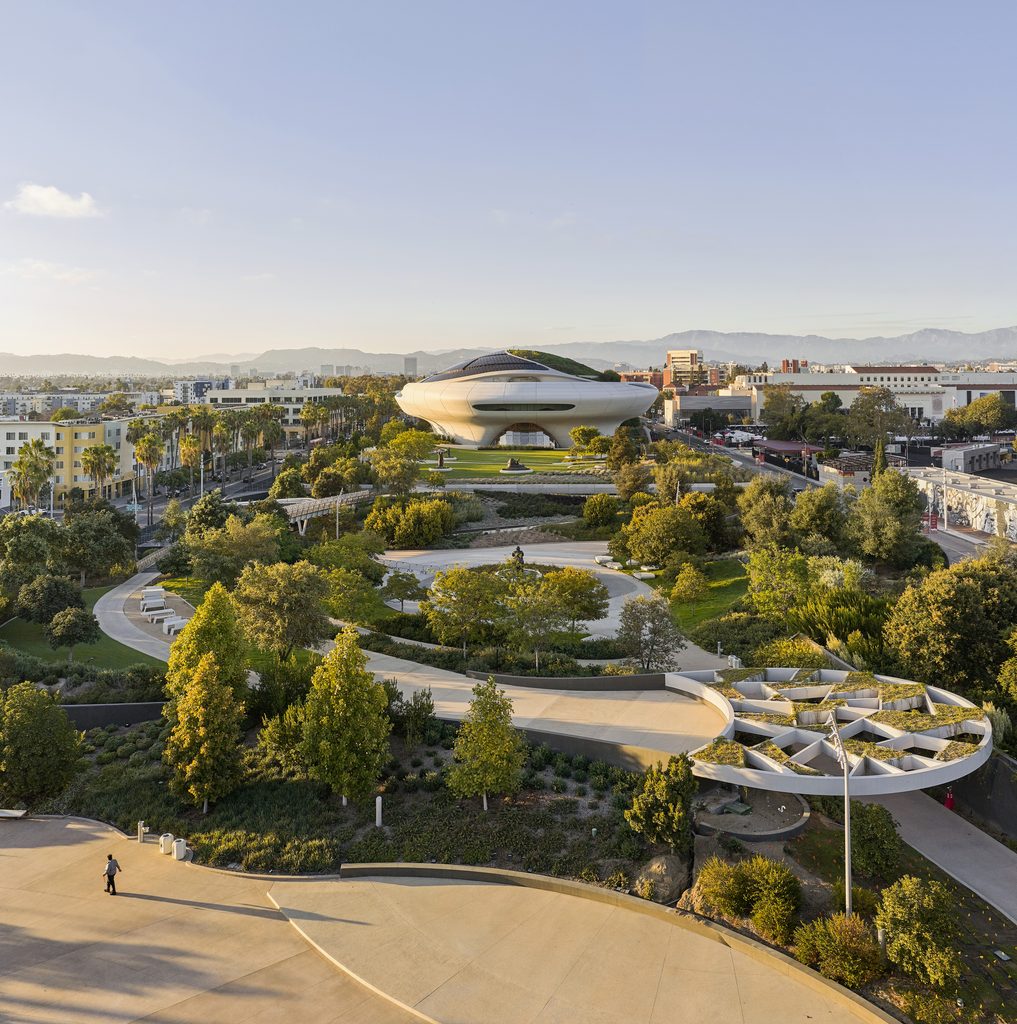
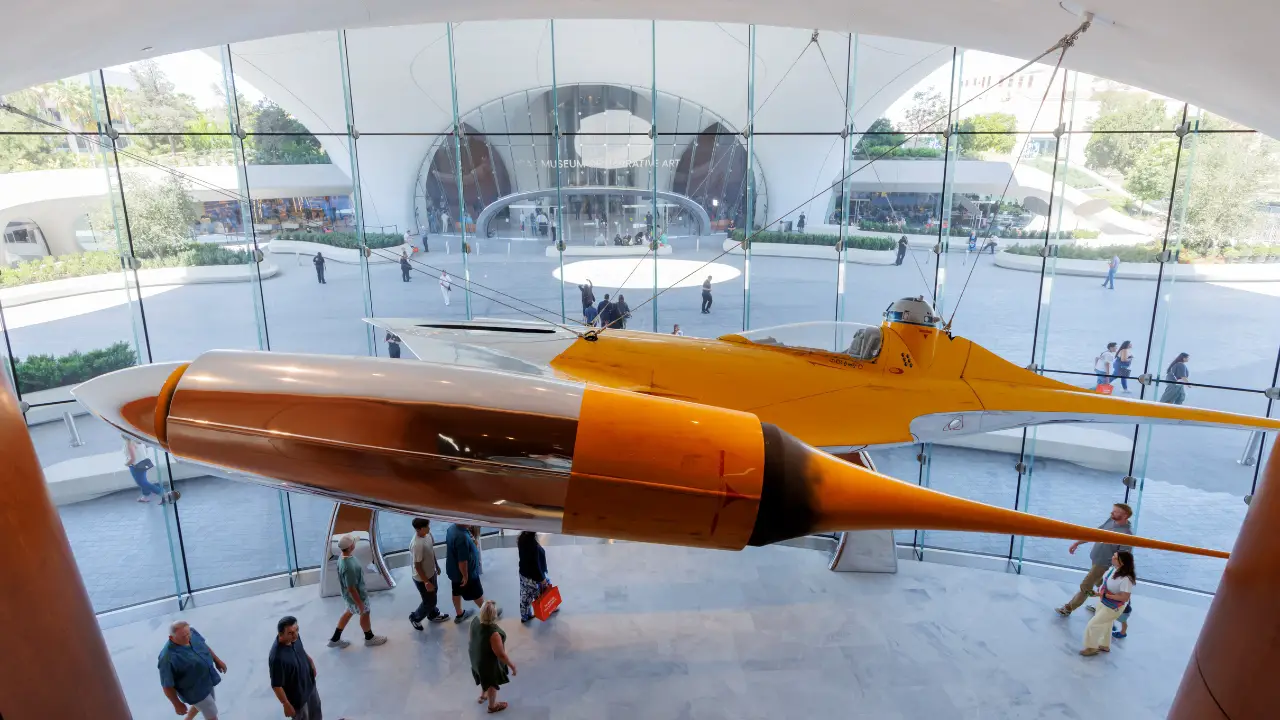
The Lucas Museum is housed in a magnificent 300,000-square-foot building that was designed by Ma Yansong of MAD with Stantec. Inside, there is over 100,000 square feet of gallery space spread across 30+ galleries. This is part of a 13-acre campus that includes a new Park and Gardens designed by Mia Lehrer of Studio-MLA. There are sculptures and a new public green space for South Los Angeles on the campus. The Lucas Museum’s inaugural exhibitions trace the history of narrative art through more than 1,300 works from the museum’s collection.
Ma Yansong said, “I am deeply grateful to George Lucas and Mellody Hobson for giving me the opportunity to create a building that will faithfully serve the visitors and the art while being as light and free as a cloud, or a dream. Designed with emotional architecture spaces, so that it is fluid in every part, and merged like a natural feature of the landscape into Exposition Park, the building invites everyone to participate in a journey of discovery and become part of the story of the Lucas Museum of Narrative Art.”
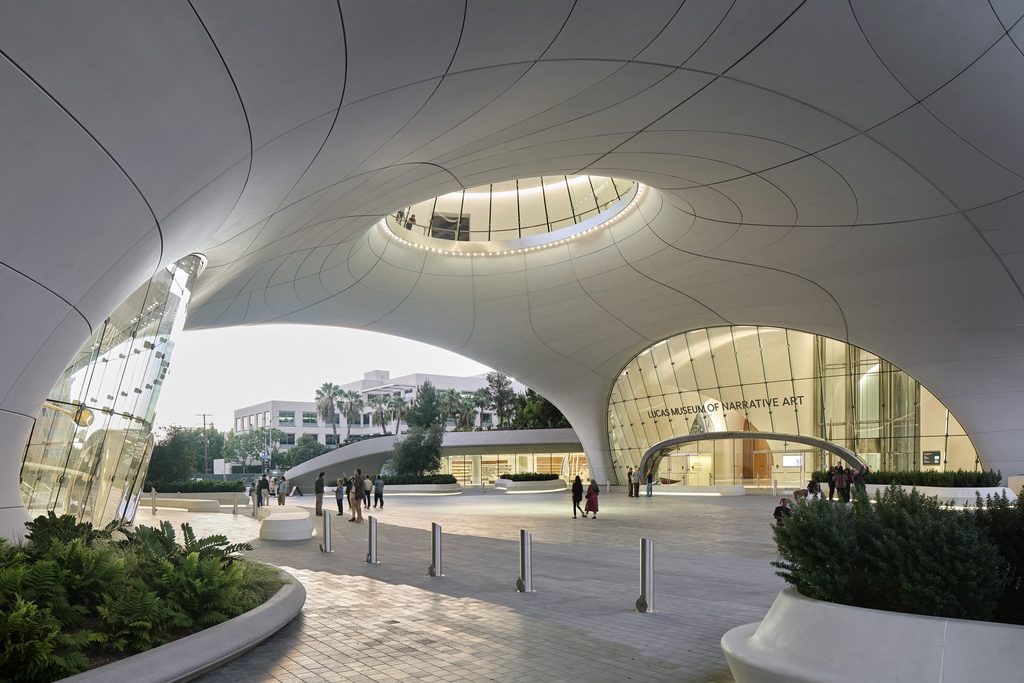
The Lucas Museum shared the following about the experience guests will have when they visit:
The story begins on the first floor in The History of Narrative Art: Heroes • Myths • The Sacred, an introduction exploring how visual storytelling has produced mythologies that inspired devotion, forged communities, and shaped societies. Signature pieces from the Museum’s collection, joined in this gallery by stunningly faithful reproductions of immovable artworks, architecture, and archeological sites from around the world, trace these stories across tens of thousands of years. Taken together, these works show that visual storytelling is not only a universal human instinct but also a tool used by church and state alike to communicate values, assert power, and define belief.
Many of the reproductions on the first floor were created by the Museum using innovative technology in collaboration with institutions, sites and governments around the world. Examples include the Vatican Museums for the Sistine Chapel ceiling, the Louvre for the Winged Human-Headed Bulls from the Palace of Sargon II, the National Museum and Research Center of Altamira in Spain for ancient cave paintings, and Mexico’s Instituto Nacional de Antropología e Historia for the Aztec Sun Stone. High-resolution images and 3-D scans of the original objects captured by the Museum to create the reproductions have been donated to the collaborating partners. The result is a unique, single gallery encounter with works that visitors could otherwise see only by traveling around the globe.
Expansive galleries on the Museum’s fourth and fifth floors present works from the collection in installations dedicated to themes, artistic mediums, and the achievements of individual artists. Thematic galleries explore myths of love, family, and community, across generations, as seen in classics of children’s literature, images of courtship and motherhood, scenes of labor, sport, and recreation, and illustrated tales of danger and daring. Artists represented in these galleries range from Vincent van Gogh, George Bellows, and Jacob Lawrence to Beatrix Potter, Charles White, and Ernie Barnes.
Exhibitions devoted to specific genres of storytelling—fantasy, romance, adventure—feature works by artists including George Méliès, Boris Vallejo, Julie Bell, and Ken Kelly. Exhibitions that showcase artistic mediums—comic books, manga, graphic novels, photography, and murals—include artists such as George Herriman, Charles Schulz, Jim Lee, Frank Miller, Takashi Murakami, Robert Capa, Gordon Parks, Diego Rivera, JR, and Judith F. Baca.
American artists who were among the giants of 20th-century illustration are honored in the inaugural exhibition with individual galleries. These artists include Norman Rockwell, N.C. Wyeth, Jessie Willcox Smith, Maxfield Parrish, Frank Frazetta, and Thomas Hart Benton.
Drawing on the works in the Lucas Archives, the inaugural Cinema gallery installation will present a special exhibition titled Star Wars in Motion, focusing on the land vehicles seen in the first six films of George Lucas’s saga. On view will be concept designs, props, and costumes associated with the films’ high-speed racers, hulking transports, and flying vessels, from Luke’s Landspeeder in A New Hope (1977) to the first physical build of General Grevious’s Wheel Bike in Revenge of the Sith (2005).
Paying tribute to architect Ma Yansong as a narrative artist in his own right, the inaugural exhibitions will also include an installation of drawings, renderings, and photographs of his visionary work for MAD, including the Lucas Museum and other projects.
A gallery on the fifth floor dedicated to large-scale, monumental storytelling in public contexts highlights how murals reflect history, identity, and shared social memory. Highlights include works from the extensive archive of Chicana muralist Judith F. Baca’s famous half-mile-long mural, The History of California (commonly known as The Great Wall of Los Angeles). Additional highlights include large-scale works and studies by renowned muralists such as Mexican modernist Diego Rivera and French contemporary street artist JR, as well as iconic pieces alongside never before seen acquisitions direct from the studio of renowned street artist Banksy.
There will also be an inaugural film program that celebrates cinema as both a powerful vehicle for narrative and a groundbreaking technology for creating moving visual experiences. More information about this program can be found here.
For more information and to purchase tickets to the Lucas Museum, visit lucasmuseum.org/plan-your-visit. Are you excited about the opening of the Lucas Museum? Are you going to visit it? Share your thoughts and opinions in the comments below!