0:10
>> Hey all you D23ers, if you can hear me,
0:13
you're in the right place. Gather around
0:15
the center stage because our next
0:17
Imagineering presentation is starting
0:20
right now. Wow, look how I call them all
0:24
over. I love having this kind of power.
0:33
Hello. Hello and welcome to the
0:36
Imagineering Pavilion.
0:43
Um, if I fall down, will somebody grab
0:46
me? Um, welcome to the Imagineering
0:49
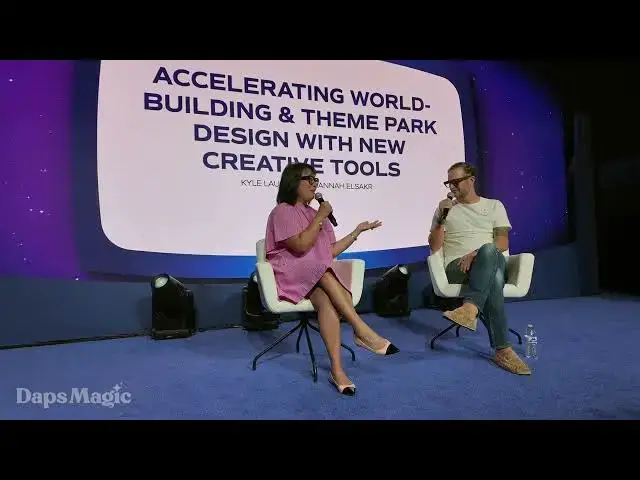
Panel. My name is Kyle Laughlin and I am
0:52
the senior vice president for R&D and
0:55
technology and engineering uh here at
0:57
Imagineering. Um I look after the team
1:00
that built all of that incredible stuff
1:03
uh in the back there um with our food
1:06
truck, our and felons and uh the great
1:09
work that we've done on Smugglers Run.
1:11
And I'm joined here by Hannah. Hannah,
1:13
you tell the group uh who you are and
1:15
what you do at Adobe. Well, I'm a big
1:17
Disney fan, first of all. But, uh, I'm
1:19
Hannah Eler. I'm from Adobe, so
1:22
hopefully there are a couple of
1:23
Photoshop. Woo. All right. Premier
1:26
Illustrator users here. Um, I run um new
1:29
ventures on new products for Adobe. So,
1:32
I was really delighted to be invited uh
1:34
to my very first D23.
1:37
>> And what have your impressions been so
1:39
>> I mean, Phantom runs deep
1:42
and it's incredible. I will say, is this
1:45
not the best pavilion? That the buildout
1:48
is incredible. All the experiences has
1:50
been incredible. Um, and so it's been
1:52
>> It's the best one we've done. And uh,
1:54
tremendous work by the team here to put
1:56
this all together. Um, we talk a lot
1:59
about creativity obviously with
2:01
Imagineering. It's core to what we do
2:03
every day. And we recently announced a
2:06
partnership between the Walt Disney
2:08
Imagineering and Adobe to do something
2:10
that we've never done before. then I'd
2:12
love for you to talk a little bit about
2:14
what um the new products that you're
2:16
working on and the one that we've
2:18
started to build together.
2:20
>> So, you know what I'm really what I
2:23
think we found a lot of uh commonality
2:25
in between our companies between Walt
2:27
Disney and Adobe is really putting the
2:30
creative and the creator at the center
2:32
of the process. Right? creativity is
2:35
innately human and the idea of using
2:38
technology to really boost that has been
2:40
a mission fit for both of us and so um
2:43
not to date us but uh Photoshop came out
2:46
in the 1990s and that was really the
2:48
first tool that democratized how all of
2:51
us could start working in a digital
2:53
format. Maybe we were in a physical
2:55
format but we wanted to work in a
2:56
digital format. Of course, After Effects
2:58
with VFX started bringing us into that
3:01
um era. And so the next generation um
3:04
you know Kyle and I started talking
3:06
about it um he and his leadership team
3:08
are all about putting more value in
3:11
front of the guests, right? Bringing
3:13
bringing the attractions sooner,
3:14
refurbishing them sooner, imagining them
3:16
sooner. And so one of the new products
3:18
that we worked together was really about
3:20
how could you ideulate faster? you
3:23
talked to me about a process of
3:25
sketching and then turning it into 2D
3:28
and 3D renders which just took a lot of
3:30
time. And so the partnership you and I
3:34
have and I'd love for you to talk about
3:35
it and give me feedback if you'd like is
3:38
um to speed that along, right? Because
3:39
we're all craving new experiences and
3:41
really fresh experiences and we don't
3:44
want to wait, right? We're really
3:45
impatient. So that's kind of the work
3:46
that we're doing together.
3:47
>> Well, I think that's really important.
3:49
Speed does matter. As you can all see,
3:52
uh, at this pavilion, we have an
3:54
incredible amount of work in front of
3:56
us, and this is just the beginning.
3:58
There's so much more that we could do.
4:00
Um, but as you can imagine, there's a
4:02
tremendous amount of back and forth that
4:04
happens in order to get to the creative
4:07
output that we're all looking for. And
4:08
so, I think, you know, with such a rich
4:10
legacy that we have within Imagineering,
4:13
we have over 70 years worth of data. We
4:16
have every single drawing, every single
4:18
model, every single Mckette we've ever
4:20
created and um you know those uh are
4:24
kind of spread all over the world.
4:25
They're in people's heads. All of that
4:27
information kind of lies somewhere else.
4:29
And um our partnership now gives us the
4:33
opportunity to create a responsibly
4:35
trained artificial intelligence model
4:38
that allows us to make outputs that are
4:41
on brand and also deals with some of the
4:44
interesting aspects of the way we design
4:46
theme arts here. You want to tell the
4:48
team a little bit about what you learned
4:50
>> Yeah. So you know new vocabulary uh for
4:53
me when we started working and I think
4:55
this is really important that there's 70
4:58
years I'll call it a knowledge graph
4:59
within imagineering now these imagineers
5:02
have technical drawings park photos
5:04
sketches ideation around that um and
5:07
they wanted us to work together in a um
5:10
completely IP protected IP driven by you
5:14
guys um and only for your use to drive
5:17
towards technically accurate drawings.
5:20
And one thing the models kept doing
5:22
because in the world we live in, we like
5:24
rectangles, right? We like our walls to
5:26
be 90°. Uh, but Kyle was like, "Hannah,
5:29
we need crooked." I'm like, "What's
5:31
that?" He's like, "Go back to Toontown.
5:34
Go visit Toontown and see what we're
5:35
building." So everything looks a little
5:37
off, right? I think Olaf was here
5:39
before. Olaf's coming later. These are
5:41
things where like the head and the body
5:43
maybe proportionally looks a little
5:45
little different. So that's what we had
5:46
to actually adjust for as we work
5:48
together. to account for that really
5:51
magical creativity and eye.
5:54
>> Absolutely. And so what this model has
5:56
done and what we're really excited about
5:57
is that uh an Imagineer can use their
6:00
existing workflow. They can go into
6:02
Photoshop uh they can go into After
6:04
Effects, they can go into Premiere and
6:06
they can uh begin to use this model to
6:09
accelerate their workflow. they can go
6:11
from sketch, snap that picture, uh uh
6:15
train that model, and then begin to go
6:16
to 2D um as fast as possibly can using
6:21
all of the understanding of uh Radiator
6:24
Springs, all of the understanding that
6:25
we might have in the world of Frozen to
6:28
quickly build new facades, new
6:31
characters, new designs, um as we think
6:34
about laying out these brand new worlds.
6:36
And that saves us a tremendous amount of
6:39
time. Um, allowing us to bring it to
6:41
fans faster than ever.
6:43
>> Maybe just one geek out point if that's
6:44
okay. I'm trained as a mathematician so
6:46
forgive me for a second. But when you
6:48
know when Kyle's talking about how these
6:50
imagineers and if you're meeting them on
6:52
the floor, I mean these people are
6:53
incredible. They're engineers. They're
6:55
3D modelers. They're um 3D modeling
6:58
takes a lot of mathematics. And so if
7:00
you're just right an artist who hasn't
7:03
studied deep math, maybe that's a skill
7:05
that you're just not able to enter into
7:08
and you're thinking about vectors and
7:09
angles and how do I model these things
7:11
and what's the volume of the cube that
7:13
I'm drawing. This actually in this
7:15
process I think the imagineers turn into
7:18
superheroes in a way because it really
7:20
flattened that process where you could
7:22
take a sketch, turn it into 2D, not have
7:25
to think too much about the math of it
7:27
and volumes and then end up with 3D
7:30
render. And what you were telling me was
7:32
sometimes in the regular process you get
7:35
to an engineering block too late, right?
7:37
We're down to remaking the ride
7:40
>> and engineers like well that's not how
7:42
what I thought it was going to be. If
7:44
you can bring that upstream, it feels
7:46
like you'll actually avoid costly
7:49
mistakes um that come later.
7:51
>> That's exactly right. I think we
7:52
increasingly are using simulation tools
7:55
to be able to ensure that we have great
7:58
sight lines that we are ensuring that
8:00
that we've got the right scale and
8:01
scope. And as you or any of you know
8:03
who've seen Olaf in the past, we you
8:05
know take Olaf before we even uh you
8:08
know assemble a symbol a a symbol
8:11
actuator a single actuator. We uh are
8:14
into simulation using reinforcement
8:16
learning. Now we're able to go from
8:18
sketch to a ride vehicle in mere minutes
8:22
and being able to then move that into
8:24
simulation and start actually looking at
8:27
some of the big time effects that come
8:29
much later when you get out into the
8:30
field. So before we pour a single uh
8:34
piece of concrete um we are able to move
8:36
so quickly and understand the
8:38
implications of our designs uh so much
8:41
>> Will you tell them the story about Olaf
8:42
and the boat that you told me?
8:44
>> Well, of course I will.
8:47
So I not necessarily as a part of this
8:50
particular conversation.
8:51
>> Just a good story.
8:52
>> Hannah and I spent a lot of time
8:53
together. Um the uh as you know when we
8:56
launched uh Olaf in uh in Paris for
9:00
Adventure World um a few months before
9:02
we launched the live entertainment team
9:05
came to us and said we got this great
9:06
idea. Nobody can see Olaf right now when
9:09
he's on the floor um walking around the
9:11
area. So we want to put him on a boat to
9:15
ensure that people can see it and then
9:17
fire fireworks behind him in order to be
9:19
able to do that. So the team as in as um
9:22
you know brilliant people as they are,
9:24
we assembled a boat inside of uh our our
9:28
R&D facility and they rocked the Olaf
9:31
back and forth to ensure that he would
9:33
stay on the boat as a part of that
9:34
piece. I think it took a lot of
9:36
carpenters and trips to Home Depot in
9:38
order for us to make that
9:40
>> your your expense report from Home Depot
9:41
you told me was very high,
9:43
>> very high. But um again just I think
9:46
what we all do as Imagineers um is we
9:49
use the best tools that we have at our
9:51
fingertips and some of those things are
9:53
foam and clay um and some of those
9:56
things are some of the most advanced AI
9:57
models in the world. Um and so what do
10:01
you think about you know you're
10:02
obviously talking to other people other
10:04
creative teams around the world that are
10:07
starting to use products like this. What
10:09
are you hearing from some of those teams
10:11
as um you know that could apply to the
10:13
work that we do kind of into the future?
10:15
What are some of the themes that you're
10:16
hearing from others in the space?
10:18
>> I work with um artists in the space as
10:21
well. Uh and just to tell you a story
10:23
from our history, you know, um we use
10:26
Photoshop like a verb now with with no
10:29
friction in our language. But when we
10:31
launched Photoshop in the '9s, um, you
10:34
know, at that point, the transition from
10:36
like physical craft to digital was very
10:38
new. The idea of digital art. Um, and so
10:42
we actually brought in David Hawkney,
10:44
who who just passed away this past
10:45
summer, but um, he he was well known in
10:49
the physical space, but he had not been
10:51
well renown yet, right, in the digital
10:53
space. So, we had him in for a creative
10:55
jam and and I feel like his art form
10:58
really legitimized the idea of digital
11:00
art as a high art form. And so, I feel
11:04
like we're in those transitions again.
11:06
Um, I work with this really incredible
11:08
artist, um, Norman Teague. He's a
11:10
furniture designer. Uh, he showed up at
11:12
MoMA and he's doing Obama's presidential
11:15
library furniture. He's a physical
11:16
artist, right? He's going to build foam
11:18
locks. He's going to end up building the
11:19
furniture. But what he told me was, I
11:22
have so many ideas and normally he and
11:24
his team can only unlock four things
11:27
that he might sketch in ideation. And so
11:29
this feels like a very similar problem
11:31
that that we talked about which is
11:34
people who are creative have thousands
11:36
of ideas in their sketchbook and we are
11:38
limited by time and space. And so
11:40
sometimes we overly constrain our
11:43
imagination because we don't have time.
11:46
And I think what we're finding when you
11:48
said you can sketch and turn something
11:50
into a 3D render in minutes or hours,
11:53
not months, means that what when I say
11:57
more value in front of your guest, let
11:59
the imagineers explore hundreds of
12:02
ideas, not four ideas. Right? Norman's
12:04
now for furniture able to do hundreds of
12:06
ideas. He actually says he likes the
12:08
hallucinations of models because it puts
12:11
things together for him that he might
12:12
not have considered. But I think that's
12:14
that's what we're celebrating here,
12:16
right? Which is how can we unlock
12:18
creativity, maybe democratize it more,
12:21
and by doing that, we get to we get the
12:24
great experience at the end of the day.
12:25
>> Absolutely. I I think that's a really
12:27
important point. I sometimes as a part
12:29
of the creative process, understanding
12:31
what you don't want is as important as
12:34
what you do. And so seeing things that
12:37
may have been in the back of your head,
12:38
you're like, "Oh man, I wish I just
12:40
would have had some more time to try
12:41
that." um to say it was a bad idea um
12:45
and then to move on to the right one is
12:47
incredibly powerful and the
12:49
hallucinations actually do really work
12:52
when it comes to physical products. So
12:54
when we were looking at Jafar's staff
12:56
and trying to look at headdresses from
12:59
some of our um you know most popular
13:01
films um that kind of hallucination
13:05
really brings some texture and life to
13:08
what you can see and and see those
13:10
things in in 3D and physical products.
13:12
It's pretty powerful which normally
13:14
would have taken again months to try and
13:16
see it in that form um all the way uh
13:20
>> and again always governed by a artistic
13:23
vision, right? You're not setting it and
13:24
forgetting it and in any process that
13:26
just ends up in kind of mediocre output
13:29
>> Absolutely. So when you think about uh
13:33
where the future is is headed um you
13:36
know where do you see creativity going
13:38
and you know what could we continue to
13:41
what if you had a dream what could we
13:42
continue to go do together?
13:44
>> Oh wow. Okay this is a very wide
13:47
question. Um, so I mean the way I think
13:49
of it, um, every kind of big tectonic
13:52
shift in creativity opens up more
13:55
things, right? I talked about digital
13:57
and, um, from physical. CGI is a great
14:01
point, right? Like, you know, there were
14:02
map paintings before in in effects and
14:05
then CGI and green screens really
14:07
brought us to a whole another level of
14:09
quality of what we're going to see in
14:10
pixels and frames. And I think here
14:13
we're we're probably on the verge of
14:14
another I'll call it a creative
14:16
renaissance. And the difference here is
14:19
um in almost every tectonic shift before
14:23
we each had to specialize like you know
14:25
I'm a vector artist and what I really
14:27
understand is vector or 3D or something.
14:30
I actually think what the
14:31
democratization that brings forward in
14:33
tools lets someone who might work in one
14:38
um stills actually be able to work
14:40
across and maybe do a little motion.
14:42
They won't become an expert in motion
14:44
but be able to to go across I think is
14:47
what we call omni modality. Really
14:49
really exciting. That's one. The second
14:51
thing I mean look at fandom here right?
14:54
Wouldn't we like a method um and I've
14:57
done this with some brands um where we
15:00
can we can put the IP in the hands of
15:02
fandom because what a lot of fans have
15:05
said to me is I want to drive the
15:07
narrative of the next you know we we did
15:09
something called un unfinished film
15:11
where we worked with the film director
15:13
and he left kind of just a minute open
15:16
of the film and he had everyone kind of
15:20
give their vision of what that me one
15:22
minute fill was And that's the idea of
15:24
letting fandom with permission drive IP
15:29
and stories. I think that's actually
15:31
going to be super exciting for all of
15:33
us. Like I want in on that first.
15:35
>> I love it. I love it. And I think really
15:37
where um we're so excited about where
15:40
this partnership is heading is that as
15:42
you said, we aren't replacing any of the
15:46
tools that over the last 70 plus years
15:48
that we've used to build the experiences
15:50
that all you all have a chance to visit.
15:53
The real opportunity here is to continue
15:56
to put another tool in the toolkit to
15:58
create uh a Jarvis, if you will, for our
16:02
Imagineers to be able to use as a as a
16:05
co-pilot or as a artificially
16:07
intelligent agent um working on behalf
16:09
of them, which is really exciting. Um
16:12
but, uh I think the there's so much uh
16:15
more that our guests are going to see as
16:17
a result of some of the things that
16:18
we're working on. But as we think about
16:20
wrapping up, I think uh one of the
16:22
things that I'd just love for you to
16:24
share and we'll kind of tie this up in a
16:26
bow at your first D23 was just to share
16:29
what your first Disney experience was is
16:32
um and what you're looking forward to as
16:34
you walk out of the pavilion today. What
16:36
are you going to go see?
16:38
>> Okay. So, my first Disney experience um
16:41
I'm a I'm a kid born in the 70s. Again,
16:44
don't judge me for age, but um my father
16:46
was an immigrant. My parents were
16:47
immigrants to this country and um you
16:50
know he worked three jobs, four kids in
16:52
the family. We lived in New York and I
16:54
remember the first vacation we could
16:56
really take. I was probably about 6
16:58
years old. My dad put us all in the
17:01
Chevy Malibu brown really ugly brown
17:04
back, you know, uh station wagon. And he
17:06
was like, I'm taking you back to
17:08
Orlando. Because to him that was really
17:11
kind of we made it. like this is the
17:14
American dream and we're going to go and
17:16
we're going to ride all the rides and
17:18
we're going to have my mom says we drank
17:20
a little bit too much soda there so we
17:21
were a little bit loopy but to me that
17:24
was my first family experience so I
17:26
think bringing bringing it full circle
17:28
my family is here with me where will I
17:30
go next I'll walk around here but really
17:33
they want to be back at the park in the
17:36
park right but isn't that the the beauty
17:39
of it so we always come back and it's
17:41
just it's like a happy family memory
17:43
that that we that we have.
17:44
>> Yeah. Well, I want to thank you for
17:46
being here today. I want to thank you
17:48
for helping me tell the story about how
17:50
we're working together and, you know,
17:51
really truly what we think we're going
17:53
to do in terms of innovating for the
17:54
next generation of uh themed experiences
17:57
that we're about to go create. Um, and
18:00
um, I'm excited for all of you to see
18:02
what some of that work is um, that no
18:04
one will let me talk about right now,
18:06
but we will share with you shortly in a
18:08
couple hours um, at the Honda Center.
18:10
So, thank you very much for joining us
18:12
here today. Really appreciate it. And uh
18:15
have a great rest of your day 23. Good